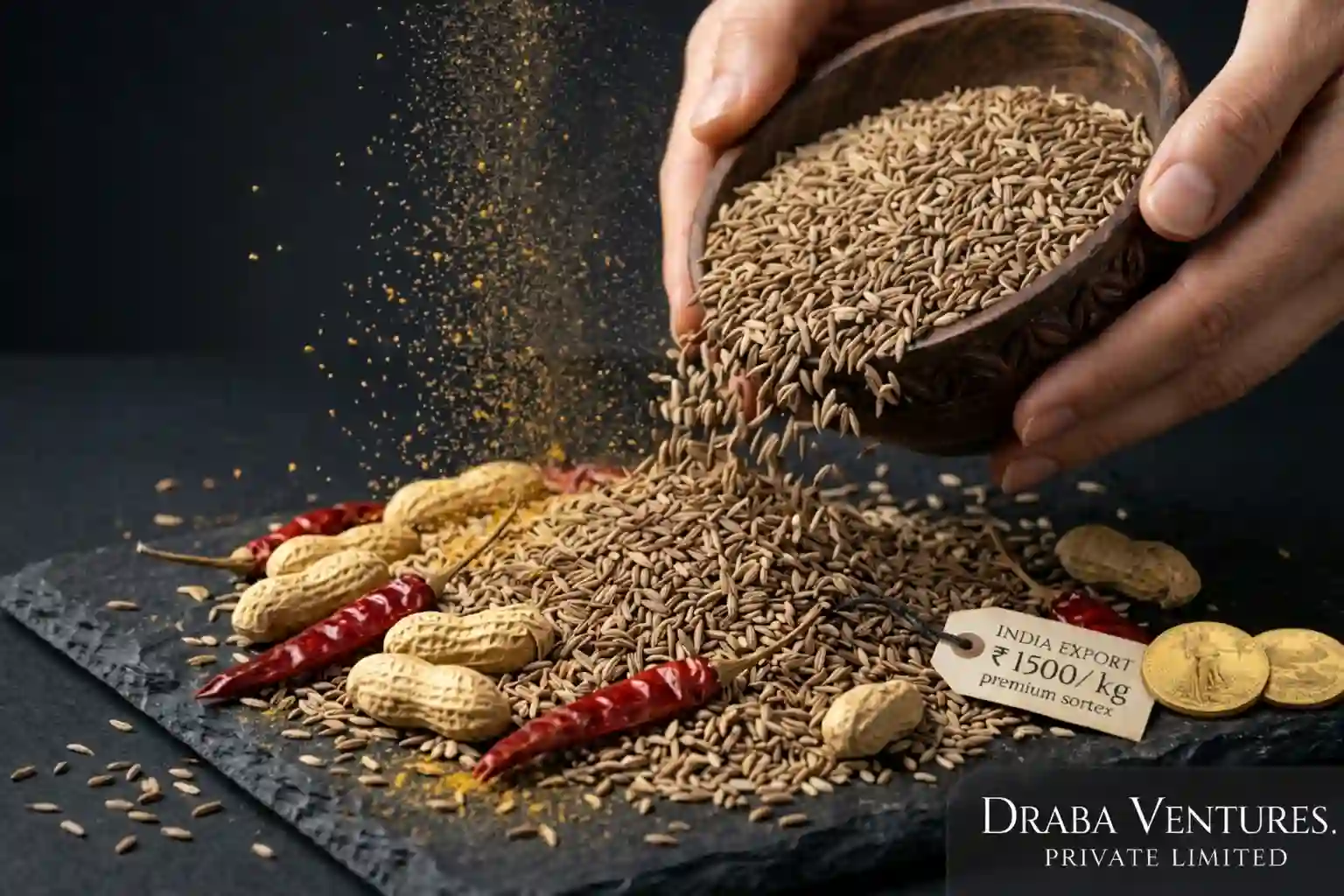
Executive Procurement Summary: India accounts for roughly 70% to 75% of global cumin supply. Spot benchmark pricing originates at Unjha Mandi in Gujarat. In 2026, FOB export quotes range from $2,500/MT for standard FAQ commercial grade up to $3,800/MT for optical Sortex 99.5% purity Singapore/European grade (volatile oil > 3.0%, EU MRL compliant). Prime purchasing windows open immediately post-Rabi harvest from March through May.
Cumin — known as jeera in India — is one of the most traded spices in the world. India is by far the dominant producer and exporter, accounting for roughly 70-75% of global supply. The primary producing states are Gujarat (with Unjha as the world's largest physical cumin trading hub) and Rajasthan (Barmer, Jodhpur, Nagaur), supplemented by production in Madhya Pradesh.
If you are an importer in the European Union, North America, the GCC or Southeast Asia sourcing cumin seeds in 2026, navigating price volatility, quality certifications, and pesticide compliance is essential. This operational guide details FOB price bands, laboratory specifications, trade documentation, and direct supply chain execution.
India's Dominant Position in Global Cumin Export
India produces approximately 500,000 to 600,000 metric tonnes of cumin annually, with 200,000 to 250,000 MT channeled into international export trade. Following historic pricing surges in 2023-2024 driven by weather stress in Gujarat, the 2025-2026 seasons have stabilized into sustainable procurement ranges.
Major export destinations for Indian cumin include Bangladesh, China, the United States, the UAE, Saudi Arabia, the United Kingdom, and distribution hubs across the EU and Southeast Asia. Cumin consistently ranks among India's top 5 agricultural spice exports by net foreign exchange value.
Calculate Live Cumin Export Pricing
Estimate precise FOB and CIF shipping and insurance costs for 20ft / 40ft containerloads to any global port.
Cumin Seeds FOB Price from India — 2026 Benchmark
Domestic cumin pricing is quoted in ₹ per quintal (100 kg) on the Unjha spot exchange and converted to USD per metric tonne FOB Mundra / Kandla. Quotations depend heavily on Sortex purity levels, seed bold size, essential oil fraction, and chemical residue clearance.
| Grade / Specification | Unjha Spot Price (₹/Quintal) | Indicative FOB Price (USD/MT) | Target Export Markets |
|---|---|---|---|
| Singapore Grade (Premium 99.5% Sortex) | ₹27,000 - ₹32,000 | $3,200 - $3,800 | EU, USA, UK, Singapore, Australia |
| European Grade (ASTA Cleaned 99%) | ₹25,000 - ₹29,000 | $2,900 - $3,400 | Continental Europe, North America |
| FAQ Grade (Fair Average Quality 98%) | ₹22,000 - ₹26,000 | $2,500 - $3,000 | Middle East, South Asia, North Africa |
| Bold / Machine Cleaned Grade | ₹24,000 - ₹28,000 | $2,700 - $3,200 | GCC Countries, East Africa |
| Ground Cumin Powder (High Oil Content) | ₹30,000 - ₹38,000 | $3,500 - $4,500 | Global Retail & Food Service Packagers |
Market Note: Pricing remains subject to seasonal arrivals. The lowest annual baseline occurs immediately after the Rabi harvest (March through May), while prices peak between October and January as warehouse stocks deplete prior to the next crop cycle.
Technical Quality Specifications: FAQ vs. European/Singapore Grade
Stringent compliance with international food hygiene standards is non-negotiable, particularly when shipping to destination ports in Europe, North America, and East Asia. Below are standard contractual parameters:
| Quality Parameter | FAQ Grade (Commercial) | European / Singapore Grade (Premium) |
|---|---|---|
| Moisture Content | Max 9.0% | Max 8.0% |
| Extraneous Matter / Purity | Max 3.0% (97% Purity) | Max 1.0% (Sortex 99.5% Purity) |
| Damaged / Discoloured Seeds | Max 5.0% | Max 2.0% |
| Volatile Oil Content | Min 2.5% | Min 3.0% |
| Total Ash | Max 9.5% | Max 8.5% |
| Acid Insoluble Ash | Max 1.5% | Max 1.0% |
| Pesticide Residues | FSSAI Standard Compliant | Full EU MRL & US FDA Tolerance Compliance |
| Microbiology (Salmonella) | Absent in 25g | Absent in 25g |
| Standard Export Packaging | 25 kg / 50 kg PP woven bags | 25 kg multi-wall kraft paper bags or cartons |
Cumin Seeds Customs Classification (HS Codes)
Indian customs documentation requires accurate HS tariff classifications:
- HS Code 0909.31.00: Cumin seeds, neither crushed nor ground (whole raw seed).
- HS Code 0909.32.00: Cumin seeds, crushed or ground (spice powders and coarse blends).
Ensuring that destination import permits and Indian shipping bills utilize identical 8-digit tariff classifications prevents customs clearance demurrage.
Which Grade Best Fits Your Business Model?
1. Retail Packaging & High-End Food Processing (EU, USA, UK)
European and Singapore Sortex grades are mandatory. The European Commission enforces strict Maximum Residue Limits (MRLs) on pesticides including chlorpyrifos, ethion, and tricyclazole. Importers must demand third-party analytical reports from ISO 17025 accredited laboratories (e.g., Eurofins or SGS) demonstrating complete chemical compliance.
2. Bulk Wholesale & Institutional Catering (Middle East, Africa)
FAQ and Bold Machine Cleaned grades provide the best commercial margins for wholesale markets across Dubai, Jeddah, and Cairo. These markets prioritize seed aroma and appearance while maintaining standard microbiological hygiene.
3. Industrial Spice Extraction & Oleoresin Production
Extractors should specify volatile oil content (minimum 3.0% to 3.5%) rather than superficial visual appearance. High-oil lots yield maximum concentration during steam distillation or supercritical CO2 extraction.
Mandatory Export Documentation Checklist
Every commercial containerload processed by Draba Ventures includes an exhaustive documentation package:
- Commercial Invoice & Packing List: Itemizing net/gross weights, container numbers, batch details, and FOB/CIF value.
- Bill of Lading (Clean on Board): Issued by prime container carriers.
- Certificate of Origin: Issued by authorized Chambers of Commerce or FIEO.
- Phytosanitary Certificate: Issued by the Plant Quarantine Division of India verifying freedom from quarantine pests.
- Spices Board of India Certificate: Official certificate of export registration and mandatory spice analysis.
- Third-Party Laboratory Inspection Report: Quantitative testing for moisture, volatile oil, aflatoxins, and pesticide residues.
- Fumigation Certificate: Documenting methyl bromide or phosphine treatment against storage pests.
- Halal Certification: Verified processing according to Islamic standards for GCC markets.
Key Producing Regions in India
Gujarat — Unjha (The World Capital of Cumin)
Unjha in Mehsana district is the commercial engine of the global cumin trade. Supported by fertile sandy loam soils and dry winter sunshine across Saurashtra and North Gujarat, Gujarat seeds are celebrated for their bold size, bright greenish-brown luster, and intense aroma.
Rajasthan — Barmer, Jaisalmer & Jodhpur
Rajasthan is the second largest producing state. Arid climatic conditions in Western Rajasthan yield highly aromatic seeds with rich volatile oil contents, serving as an indispensable volume buffer during periods of supply contraction in Gujarat.
Seasonal Sourcing Calendar for Importers
Understanding harvest cycles allows commercial buyers to capture substantial price advantages:
| Timeframe | Crop Cycle & Market Dynamics | Price Direction | Recommended Buyer Action |
|---|---|---|---|
| January - February | Lean period, remaining carryover stocks | Elevated / Firm | Purchase strictly for urgent inventory replenishments |
| March - April | Fresh Rabi harvest arrivals flood Unjha | Correction / Softening | Prime purchasing window: highest oil content, newest crop |
| May - July | Post-harvest supply peak in cold chains | Stable / Moderate | Ideal timing for annual fixed contracts and multi-FCL bookings |
| August - October | Cold store stocks deplete steadily | Firming Upward | Book pre-festival autumn shipments in advance |
| November - December | Pre-sowing inventory squeeze | Annual Peak | Procure selectively with tight price limits |
Partner with Draba Ventures for Direct Cumin Sourcing
Draba Ventures provides end-to-end procurement, optical Sortex cleaning, multi-wall moisture-barrier packaging, and comprehensive export documentation for containerload cumin buyers across Europe, the Middle East, and the Americas.
Request a Formal Export Quote