
An acceptable Phytosanitary Certificate for Indian rice must be issued by the National Plant Protection Organization (NPPO) of India following authorized sampling. It must carry explicit additional declarations stating freedom from Trogoderma granarium (Khapra beetle), verify non-infestation by live insects or prohibited weed seeds, reference accredited AFAS Methyl Bromide fumigation details, and correctly identify container and seal numbers matching the ocean Bill of Lading.
The Anatomy of a DAFF-Compliant Certificate
Securing seamless customs release for Indian rice at major Australian container terminals – whether through DP World or Patrick Terminals at Port Botany (Sydney), Swanson Dock at Port of Melbourne, or Fremantle Ports – requires complete alignment with Australia's Department of Agriculture, Fisheries and Forestry (DAFF) biosecurity mandates.
Unlike generic phytosanitary documents utilized for less regulated trade corridors, Australian plant biosecurity authorities will not accept generalized endorsements. The Indian National Plant Protection Organization (NPPO), operating under the Directorate of Plant Protection, Quarantine & Storage (DPPQS), must issue an official Phytosanitary Certificate that carries unambiguous statutory declarations.
The primary biosecurity concern for Australian authorities is the Khapra beetle (Trogoderma granarium), an invasive pest capable of devastating stored agricultural commodities. Every phytosanitary document must carry the explicit additional endorsement confirming that the cargo was inspected and found free from Khapra beetle across all life stages, including diapausing larvae and microscopic eggs.
DAFF Statutory Phytosanitary Certificate Endorsements & Inspection Criteria
| Certificate Section / Field | Statutory DAFF Requirement | NPPO India Verification Process | Risk of Document Non-Compliance |
|---|---|---|---|
| Additional Declaration (Khapra Beetle) | Exact wording: 'Consignment inspected and found free from Trogoderma granarium (Everts)' | Laboratory sieve analysis and visual grain sampling by NPPO plant quarantine officers | Instant container hold; quarantine red-lane direction or mandatory re-exportation |
| Offshore Treatment Endorsement | Endorsement of MBr fumigation (dosage rate, duration, temperature, AFAS ID) | Fumigation treatment provider registration verified against active DAFF offshore register | Rejection of certificate; direction for onshore re-treatment with heavy terminal surcharges |
| Botanical Nomenclature & Grade | Exact botanical name (Oryza sativa) alongside commercial milling description | Physical verification against APEDA export registration and shipping invoice | Document assessment delay in COLS system; clarification query issued by DAFF |
| Container & Seal Identifiers | All ocean container prefixes, numbers, and bolt seal numbers listed verbatim | Cross-checked at port CFS prior to seal application and gate-in | Physical inspection call-up at container terminal to verify physical seal integrity |
| Issuance Timing & Validity | Issued prior to or on the ocean Bill of Lading onboard date | NPPO certification sealed post-loading inspection within statutory clearance window | Invalidated certificate if dated post-vessel departure without prior biosecurity dispensation |
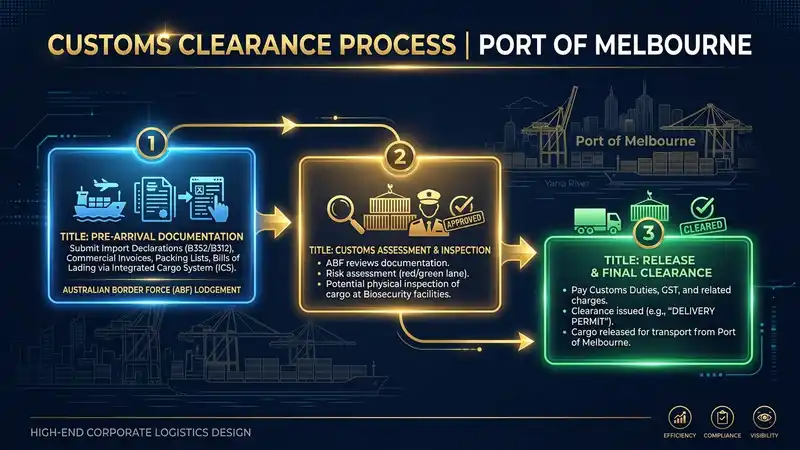
5-Stage Biosecurity Clearance Workflow for Australian Ports
Stage 1 – Authorized Pre-Shipment Inspection & Sampling in India
Authorized NPPO inspectors draw representative grain samples at the certified export mill or inland container depot (ICD). Samples undergo intensive optical and sieve testing to verify zero presence of live insect pests, soil particles, or noxious weed seeds before bagging.
Stage 2 – AFAS Methyl Bromide Treatment & Endorsement Reconciliation
Prior to container dispatch, an AFAS-accredited fumigator applies statutory Methyl Bromide gas schedules. The treatment details, including dosage rate, exposure duration, ambient temperature, and registered company ID, are incorporated directly into or cross-referenced on the official phytosanitary record.
Stage 3 – Electronic Pre-Lodgement via BICON & COLS (5 Days Prior to ETA)
Australian licensed customs brokers submit complete shipping documentation through the Cargo Online Lodgement System (COLS) and the Biosecurity Import Conditions (BICON) portal at least 5 business days prior to vessel arrival, enabling pre-berthing document validation.
Stage 4 – Targeted Seal Verification & Tailgate Inspection
Upon vessel discharge at Port Botany or Melbourne, containers routed for biosecurity review move to approved Class 1.1 or 2.2 Approved Arrangement (AA) sites. Biosecurity officers verify bolt seal numbers against the Phytosanitary Certificate and inspect door gaskets for external contaminants.
Stage 5 – Direction Release & Direct Distribution Terminal Entry
Once documentation and physical integrity are verified, DAFF issues an electronic Biosecurity Direction Release transmitted directly into terminal systems (e.g., 1-Stop). Cargo is picked up within port free-time, avoiding terminal storage penalties.
Port Botany (Sydney) vs. Port of Melbourne Biosecurity Clearance Workflow
| Clearance Stage / Parameter | Port Botany (Sydney) Protocol | Port of Melbourne Protocol | Importer Action / Commercial Timeline |
|---|---|---|---|
| Electronic Document Pre-Lodgement | Lodged via Cargo Online Lodgement System (COLS) 5 days prior to ETA | Lodged through integrated customs broker EDI and BICON gateway 5 days prior | Submit full clean document package early to achieve document clearance prior to vessel berthing |
| Biosecurity Dwell Time Target | Targeted 24 to 48 hours document assessment turnaround | Standard 24 to 48 hours automated assessment for green-lane consignments | Enables cargo pickup within 3 to 5 business days free port storage window |
| Random Seal & Tailgate Inspection | Inspections conducted at DP World or Patrick terminal Approved Arrangements (AA) | Inspections routed to approved Class 1.1 or Class 2.2 biosecurity facilities (Swanson Dock) | Carrier booking aligned with approved biosecurity transport operators to avoid missed slots |
| Quarantine Release Authorization | Electronic release transmitted directly to 1-Stop vehicle booking system | Automatic release notification sent via Melbourne Single Window portal | Truck transport dispatched immediately; eliminates terminal demurrage and detention fees |
| Discrepancy Remediation (Section 57) | Escalation to DAFF regional office at Rosebery; onshore gas chamber remediation | Escalation to DAFF Victoria biosecurity centre; supervised terminal repacking | Prevents severe cargo abandonment or $3,500+ AUD local remediation expenses |
Partner with Draba Ventures for Flawless Australian Port Clearance
Eliminate demurrage risks, quarantine delays, and document queries. Our end-to-end export documentation guarantees 100% compliance with DAFF statutory import standards.
Direct WhatsApp Sourcing DeskOfficial Telegram Procurement Channel
Frequently Asked Questions
The certificate is issued by the Directorate of Plant Protection, Quarantine & Storage (DPPQS) under India's Ministry of Agriculture, functioning as the National Plant Protection Organization (NPPO). The inspection must be carried out by authorized plant quarantine officials at the designated inland container depot (ICD) or port of departure.
DAFF strictly mandates an endorsement confirming that the rice has been inspected and found free from Trogoderma granarium (Khapra beetle). The certificate must also detail the pre-shipment treatment applied, including Methyl Bromide concentration, exposure hours, ambient temperature, and the AFAS registration number of the treatment company.
While electronic lodging of scanned documents via COLS (Cargo Online Lodgement System) is standard practice for initial document assessment, DAFF biosecurity officers reserve the right to demand the physical original certificate with embossed stamps and wet signatures before granting final release.
Draba Ventures enforces a multi-tier documentation audit before container gate-in. We reconcile the NPPO Phytosanitary Certificate, AFAS fumigation report, APEDA Certificate of Origin, and ocean Bill of Lading down to seal numbers, botanical names, and net weights, ensuring first-pass automated approval in Australia.
