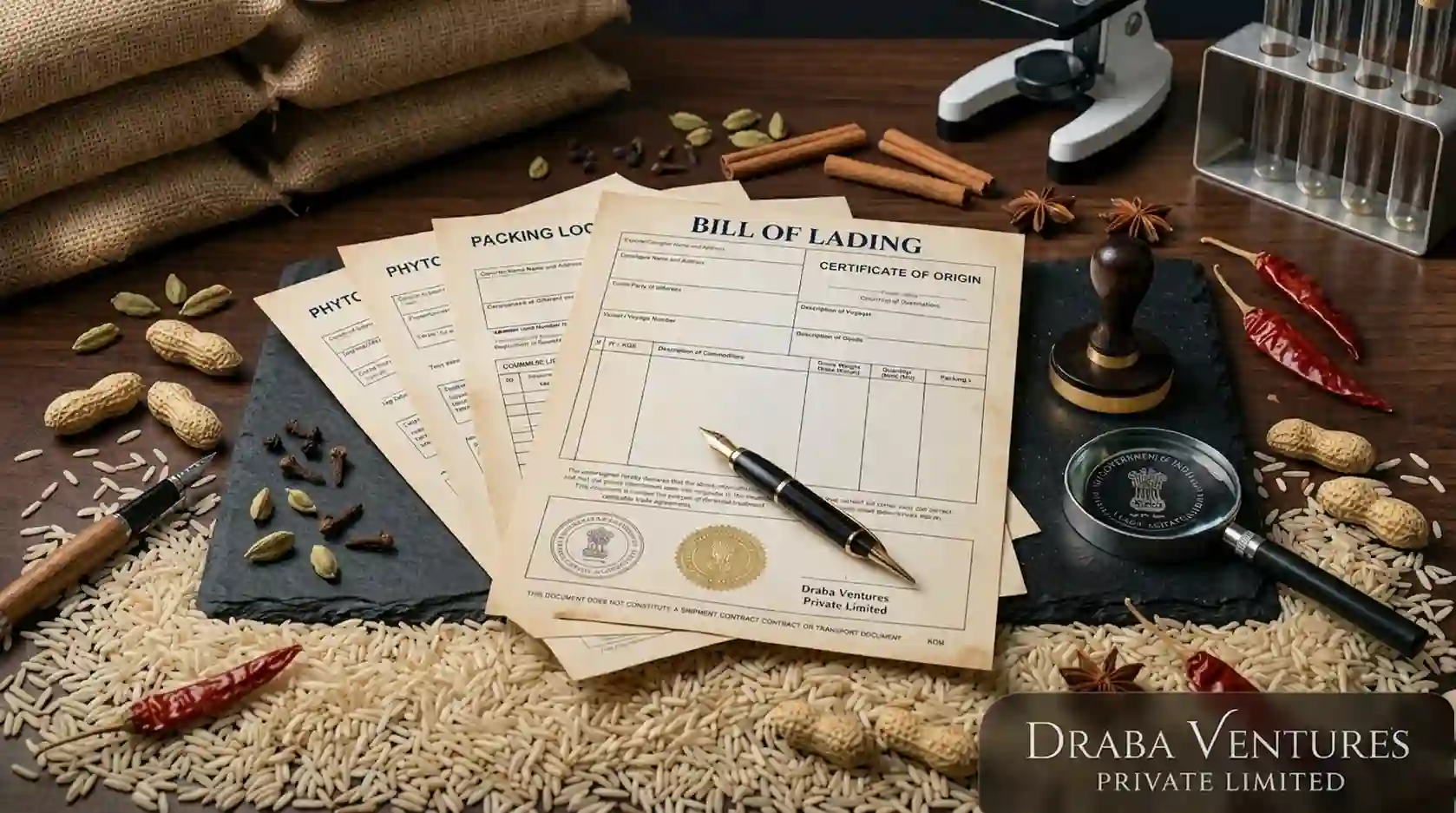
The Bill of Lading is the single most important document in any rice export shipment. It is your legal title to the cargo. Without the original Bill of Lading, the buyer cannot collect the goods at the destination port - regardless of payment made. Yet it is also the document most frequently misunderstood by new importers and exporters alike.
This guide explains every type of Bill of Lading used in Indian rice export, what each field means, how it flows between exporter, bank, and buyer under Letter of Credit terms, and the mistakes that most commonly cause delays or loss of cargo.
The Bill of Lading is issued by the shipping line - not the exporter. It is the only document that gives the holder legal title to the goods. The original BL must be presented at the destination port to release the cargo. Losing or delaying it can hold your shipment for weeks.
What is a Bill of Lading?
A Bill of Lading (BL or B/L) serves three simultaneous functions in international trade. First, it is a receipt - issued by the shipping line confirming they have received the cargo in apparent good order and condition. Second, it is a contract of carriage - between the shipper and the carrier outlining the terms of transport. Third, and most critically, it is a document of title - meaning whoever legitimately holds the original BL is legally entitled to take possession of the cargo at the destination port.
Ready to Import IR64 Parboiled Rice?
Get an instant FOB and CIF cost estimate including shipping and insurance.
In rice export from India, the BL is issued by the shipping line (MSC, Maersk, CMA CGM, Evergreen, Hapag-Lloyd, etc.) at the port of loading once the container is loaded on the vessel. It is issued in sets - typically three originals and several non-negotiable copies.
Types of Bill of Lading Used in Rice Export from India
1. Original Bill of Lading (Full Set 3/3)
The most traditional form. Three original copies are issued. Any one original, when presented at the destination port, allows cargo release. The other originals become void once one is surrendered. Under LC payment terms, the full set of originals is sent via bank to the buyer's bank. This remains the standard for high-value or first-time buyer shipments where maximum security is required.
2. Telex Release (Surrendered BL)
Telex release is now one of the most common methods in Indian rice export, especially for repeat buyers and smaller parcels. The original BL is surrendered to the shipping line at the origin port, and the buyer is notified electronically that they can collect the cargo without presenting a physical original. It is faster, cheaper, and reduces courier costs. However, it should only be used once payment has been fully received or with highly trusted buyers - surrendering the BL before payment confirmation means the buyer can collect goods without paying.
3. Sea Waybill
A Sea Waybill is a non-negotiable document - it cannot be transferred to a third party. Cargo is released to the named consignee directly without presenting any original document. This is fast and efficient but removes the document-of-title function. Used only in transactions between well-established trading partners where payment risk is not a concern.
4. Switch Bill of Lading
A switch BL is a replacement BL issued to change certain details of the original - typically the shipper's name, port of loading, or description of goods. This is used by trading companies that buy from an Indian supplier and sell to their own buyers, wanting to keep the original supplier confidential. The original BL is surrendered and a new one issued with the trader's details. Switch BLs are legal but must be handled carefully - they are sometimes misused for cargo diversion or fraud.
Comparison of Bill of Lading Formats
| BL Format | Legal Status | LC Compatibility | Cargo Release Speed | Risk Profile & Best Application |
|---|---|---|---|---|
| Original B/L (Set of 3/3) | Negotiable document of title | Fully mandatory under LC | Dependent on banking courier transit | Highest security; required for new clients and institutional trade finance |
| Telex Release (Surrendered BL) | Digital release authorization | Incompatible with standard LC | Instant upon vessel docking | Zero commercial risk only when 100% wire transfer (TT) is fully cleared |
| Sea Waybill | Non-negotiable cargo receipt | Not accepted for documentary collections | Immediate without physical presentation | Restricted to inter-company transfers and high-trust recurring buyers |
| Switch B/L | Re-issued replacement document | Subject to issuing bank pre-approval | Moderate delay for re-issuance | Preserves supplier confidentiality for multinational trading houses |
Key Fields in a Rice Export Bill of Lading
| Field | What It Should Contain | Why It Matters |
|---|---|---|
| Shipper | Exporter's full legal name and address | Must match Commercial Invoice and Certificate of Origin exactly |
| Consignee | Buyer's name, or "To Order" for negotiable BL | "To Order" enables transfer of title via endorsement |
| Notify Party | Buyer or their customs agent at destination | Port authority notifies this party on vessel arrival |
| Port of Loading | Indian port - e.g. Chennai, Nhava Sheva (JNPT), Mundra, Kakinada | Must match LC terms if paying by LC |
| Port of Discharge | Destination port - e.g. Jebel Ali, Mombasa, Felixstowe, Rotterdam | Cargo goes to this port only |
| Description of Goods | Rice variety, grade, broken %, packaging, and bag count | Must match Commercial Invoice, Packing List, and Phytosanitary Certificate |
| Container No. & Seal No. | Exact container serial and customs seal numbers | Used for cargo tracking, terminal gate passes, and customs verification |
| Gross Weight / Net Weight | Total metric tonnage of shipment | Checked against Packing List and terminal weighbridge at destination |
| Freight Terms | Prepaid (CIF/CFR) or Collect (FOB) | Determines legally who pays ocean freight charges |
| On-Board Date | Date container was actually loaded on vessel | Critical for LC compliance - must be on or before the LC latest shipment date |
How Bill of Lading Works Under Letter of Credit (LC)?
Under LC payment terms, the BL flows through a banking channel rather than being sent directly to the buyer. Here is the standard sequence:
- Exporter loads the rice containers and receives the clean on-board BL from the shipping line.
- Exporter presents the full set of 3/3 original BLs along with all other LC documents to their negotiating bank in India.
- Indian negotiating bank examines documents against UCP 600 standards - if fully compliant, releases funds to exporter.
- Indian bank couriers the original BL set via express international courier to the buyer's issuing bank in the destination country.
- Buyer's bank releases the original endorsed BL to the buyer only after the buyer settles payment or accepts the LC term draft.
- Buyer surrenders the original endorsed BL at the destination port terminal to receive the container release order.
Any discrepancy between the BL and the LC terms - even a minor one like a spelling difference in the port name or missing carrier signature - can cause the bank to raise a formal discrepancy and delay payment release. This is why the draft BL must be audited rigorously prior to vessel departure.
Under LC terms, the on-board date on the BL is critical. The LC will specify a "latest shipment date" - if the BL is dated after this, the LC becomes non-compliant and the buyer's bank can refuse payment. Always confirm the vessel's loading schedule before it sails.
Common Bill of Lading Errors in Rice Export
- Shipper name mismatch - company legal style on BL differs from Commercial Invoice due to abbreviation or spelling variations.
- Wrong port of discharge - especially common when buyer attempts to divert destination after cargo booking.
- Incorrect goods description - generic "rice" instead of "Indian non-basmati parboiled rice 5% broken" causes immediate LC discrepancy.
- Missing "Clean Shipped on Board" notation - carrier issuing a "received for shipment" notation without an on-board dated endorsement is rejected under UCP 600.
- Freight terms contradiction - BL marked "freight collect" when LC conditions mandate "freight prepaid" under CIF/CFR contracts.
- Late on-board date - ocean vessel loaded after the LC's latest shipment date window.
- Surrendering original before payment - releasing telex instructions to a new or unvetted buyer without confirmed irrevocable TT clearance.
How to Handle Original BLs Safely?
Original Bills of Lading are negotiable bearer instruments - whoever holds an endorsed original holds ownership of the cargo. Treat them with the same security as negotiable currency. Never email scanned originals to buyers as a substitute for payment settlement - scan copies are strictly for reference and cannot be used for cargo release. Always courier originals via international express couriers (DHL or FedEx) with end-to-end tracking and direct signature confirmation. If executing a telex release, confirm surrender only after irrevocable payment credit has been verified in your corporate bank account.
Frequently Asked Questions
Draba Ventures Handles All Shipping Documentation
We manage the complete documentation chain - from BL issuance and verification to courier of originals or telex release coordination. Every document matches every other document, every shipment.
Request a Quote