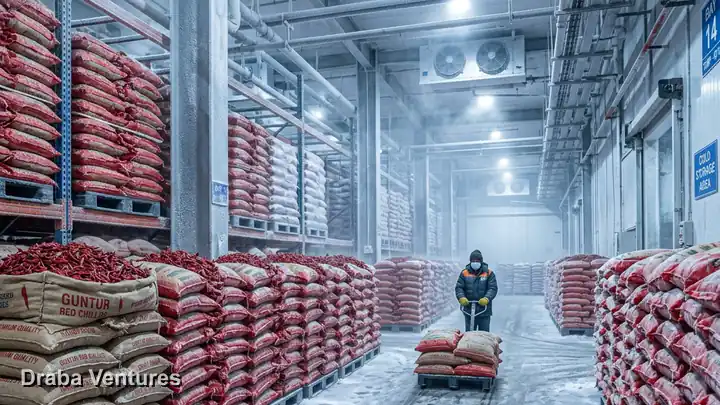
Executive Summary for Commodity Buyers: The financial decision to store Guntur red chillies post-harvest versus liquidating immediately on the spot market is strictly governed by carry-over economics. Holding stock in cold storage is only profitable when the anticipated off-season price appreciation exceeds the sum of purchase costs, monthly cold storage rent (₹120-₹160/quintal), physical moisture shrinkage (3-6%), and working capital interest (10-12% p.a.) by at least 14%. When demand forecasts are sluggish or bumper harvests occur, immediate spot market liquidation protects working capital and eliminates quality degradation risks.
Calculate Landed Costs & Cold Storage Break-Even
Estimate real-time mandi procurement rates, storage rental overheads, and financial break-even thresholds for Teja S17, Byadgi, and 334 chillies.
Complexities of Guntur Red Chilli Cold Chain Dynamics

The Guntur agricultural belt produces benchmark export varieties including Teja S17, Byadgi, and 334. Peak mandi arrivals take place between February and May, flooding the market and depressing spot prices. However, prolonged exposure to ambient summer heat in Andhra Pradesh causes swift color fading, loss of capsaicin potency, and aflatoxin contamination. Moving dried chillies into controlled cold storage (4°C to 6°C) is mandatory to preserve ASTA color values for overseas buyers.
Decoding Shrinkage Math and Weight Loss in Cold Storage
Dried chillies enter storage with 10% to 13% residual moisture. Over a 6 to 9-month holding window, continuous chilled air circulation lowers moisture levels to 7.5% to 9.5%, creating tangible physical tonnage loss. For high-value Teja S17 trading at ₹20,000 per quintal, a 4% shrinkage loss represents an immediate loss of ₹8,000 per metric ton that must be amortized into the selling price:
| Storage Duration | Expected Shrinkage % | Impact on 100 MT Stock | Financial Loss @ ₹20,000/Qtl |
|---|---|---|---|
| 1 to 3 Months | 1.5% – 2.5% | 1.5 to 2.5 MT loss | ₹3,00,000 – ₹5,00,000 |
| 4 to 6 Months | 3.0% – 4.5% | 3.0 to 4.5 MT loss | ₹6,00,000 – ₹9,00,000 |
| 7 to 9 Months | 4.5% – 6.0% | 4.5 to 6.0 MT loss | ₹9,00,000 – ₹12,00,000 |
| Over 9 Months (Carry-over) | 6.0% – 7.5% | 6.0 to 7.5 MT loss | ₹12,00,000 – ₹15,00,000 |
Refrigerant Energy Overheads and Monthly Rental Tariffs
Cold storage plants operate massive ammonia and freon compressor systems continuously. High commercial electrical tariffs in Andhra Pradesh, paired with emergency diesel generator operations during summer power fluctuations, dictate monthly rental tariffs ranging between ₹120 and ₹160 per quintal. Holding 100 MT for six months accumulates approximately ₹7,80,000 to ₹9,60,000 in pure warehouse rental charges.
Opportunity Cost of Capital and Working Capital Blockage
Procuring 100 MT of export-grade Teja chilli locks up ₹2.0 to ₹2.5 Crores in liquidity. Commercial credit facilities or warehouse receipt loans carry interest rates between 10% and 12% per annum. Freezing working capital for six months incurs an interest penalty of ₹1,200 per quintal, which must be offset by off-season market appreciation.
Holding Costs vs. Spot Market Liquidation: The Financial Formula
Traders rely on a standardized mathematical formula to determine whether to hold or sell:
| Cost Component per Quintal | Immediate Spot Market Liquidation | 6-Month Cold Storage Holding |
|---|---|---|
| Mandi Purchase Price | ₹20,000 | ₹20,000 |
| Storage Rent (6 months @ ₹130/mo) | ₹0 | ₹780 |
| Capital Interest (12% p.a. for 6 months) | ₹0 | ₹1,200 |
| Shrinkage Value Loss (4% weight deficit) | ₹0 (Sold at gross entry weight) | ₹800 (Quantity recovery compensation) |
| Total Break-Even Cost | ₹20,000 | ₹22,780 |
| Required Price Appreciation | None (Immediate Liquidity) | +13.9% minimum surge required |
Quality Preservation and Degradation Risks
While cold storage slows chemical deterioration, prolonged holding past 9 months leads to progressive ASTA color fading and pod brittleness. If unexpected power failures trigger interior condensation, aflatoxin contamination risks escalate, leading to severe price discounts upon export testing:
| Quality Parameter | Fresh Crop (Feb–May) | Cold Storage Stock (6–9 Months) | Commercial Impact |
|---|---|---|---|
| ASTA Color Value | 120 – 160 ASTA (Vibrant bright red) | 85 – 110 ASTA (Subdued red tone) | Export price discount applied by European & US buyers |
| Capsaicin Heat (SHU) | Fully preserved (Teja: 65,000–85,000 SHU) | Stable (Negligible chemical loss) | Ideal for oleoresin extraction and ground spice blending |
| Moisture Content | 10.0% – 13.0% | 7.5% – 9.5% (Brittle pods) | Higher breakage rate during commercial de-stalking and packing |
| Aflatoxin Security Risk | Low under compliant sun drying | Elevated if condensation occurs | Mandatory NABL laboratory clearance required before shipment |
Carry-Over Stock Pricing Models and Seasonal Marketing Windows
Strategic liquidation timing must align with cyclical demand spikes across the domestic and export calendar:
| Calendar Window | Guntur Mandi Dynamics | Price Trajectory | Recommended Trading Strategy |
|---|---|---|---|
| February to May | Peak harvest arrivals at Mirchi Yard | Seasonally lowest price index | Aggressive procurement for cold storage deposition |
| June to July | Monsoon onset; open yard operations halt | Steady to moderately firm | Holding phase; monitor new sowing acreage across Andhra/Telangana |
| August to November | Festive surge & spice mill procurement | Annual peak price realization | Optimal profit-taking liquidation window |
| December to January | Imminent arrival of new crop | Elevated volatility; downside risk | Complete liquidation of carry-over inventory |
Frequently Asked Questions
Optimize Your Guntur Chilli Procurement
Draba Ventures provides direct origin procurement, certified lab testing, and cold chain logistics for bulk buyers and spice processors worldwide.
Request Wholesale Quotation