In high-volume agricultural commodity imports entering the European Union and the United Kingdom, phytosanitary compliance is non-negotiable. European port health authorities and customs agencies—including the UK's Port Health Authorities at Felixstowe and the Dutch NVWA at Rotterdam—enforce some of the most rigorous food safety regulations globally. A single non-compliant consignment can result in border rejection, mandatory re-export, or court-supervised incineration.
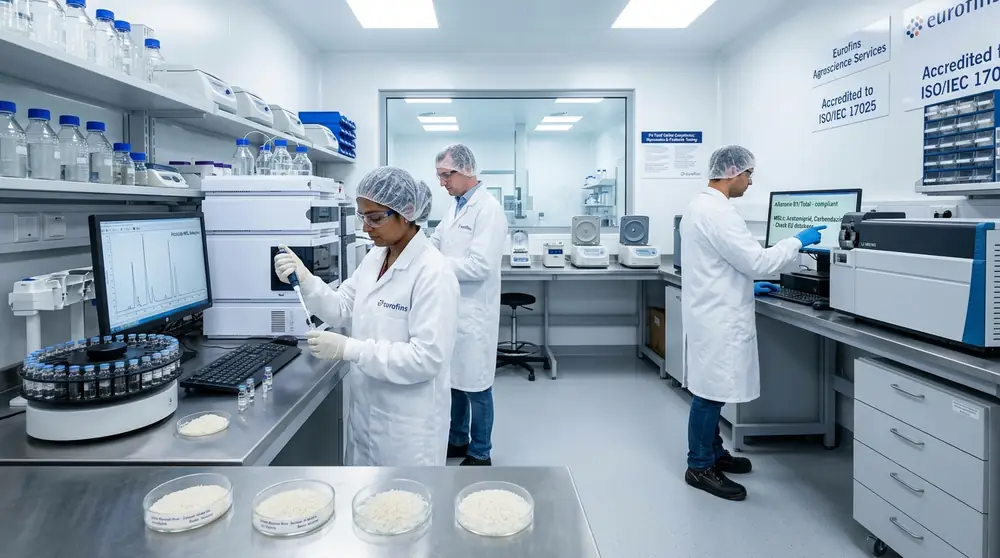
To provide European institutional distributors, millers, and ethnic food conglomerates with absolute supply security, Draba Ventures benchmarks every export lot against certified Eurofins Scientific testing. Pre-testing each consignment through NABL and DAkkS-accredited Eurofins laboratories transforms customs clearance from an operational gamble into a predictable, green-channel formality.
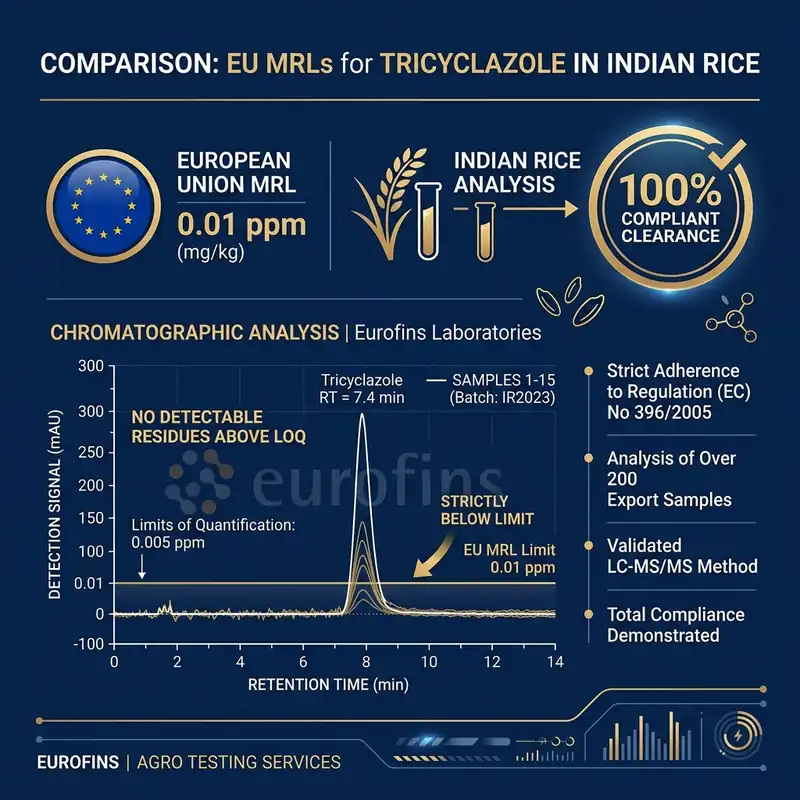
European border agencies test agricultural imports using liquid chromatography-tandem mass spectrometry (LC-MS/MS) capable of identifying chemical residues down to parts-per-billion. Draba Ventures mirrors this analytical procedure prior to sealing containers in India. By screening for over 500 pesticide compounds—including strict compliance with the 0.01 mg/kg limit of quantification for Tricyclazole—alongside aflatoxins and heavy metals, our verifiable Eurofins Certificate of Analysis (CoA) guarantees rapid release through TRACES and IPAFFS without costly container demurrage.
Key Analytical Benchmarks for European Clearance
Table 1: Statutory EU/UK Pesticide MRL Thresholds and Testing Standards
Under Regulation (EC) No 396/2005 and Great Britain equivalent statutory instruments, the table below outlines the core maximum residue limits (MRLs) and analytical tolerances enforced on non-basmati and basmati shipments:
| Testing Parameter | EU/UK Statutory MRL | Draba Ventures Export Spec | Testing Protocol & Instrumentation |
|---|---|---|---|
| Tricyclazole (Fungicide) | 0.01 mg/kg (Analytical LOQ) | Non-Detectable (< 0.01 mg/kg) | LC-MS/MS Tandem Mass Spectrometry |
| Buprofezin (Insecticide) | 0.01 mg/kg (Analytical LOQ) | Non-Detectable (< 0.01 mg/kg) | LC-MS/MS Multi-Residue Extraction |
| Isoprothiolane | 0.01 mg/kg (Analytical LOQ) | Non-Detectable (< 0.01 mg/kg) | Gas Chromatography (GC-MS/MS) |
| Carbendazim & Benomyl | 0.01 mg/kg (Analytical LOQ) | Non-Detectable (< 0.01 mg/kg) | Liquid Chromatography (LC-MS/MS) |
| Aflatoxin B1 | Max 2.0 µg/kg (ppb) | Compliant (< 1.0 µg/kg) | HPLC with Fluorescence Detection (FLD) |
| Total Aflatoxins (B1+B2+G1+G2) | Max 4.0 µg/kg (ppb) | Compliant (< 2.0 µg/kg) | Immunoaffinity Clean-up Column & HPLC |
| Inorganic Arsenic | Max 0.20 mg/kg (White Rice) | Compliant (< 0.15 mg/kg) | ICP-MS Inductively Coupled Plasma Mass Spectrometry |
| Lead (Pb) & Cadmium (Cd) | Max 0.20 mg/kg / 0.04 mg/kg | Strictly within limits | ICP-MS Heavy Metal Elemental Screen |
The 5-Stage Eurofins Laboratory Verification Protocol
Stage 1 – Representative Primary Sampling (ISO 24333)
Quality begins at the storage facility. Draba Ventures inspectors collect primary grain increments across stratified silo points in Sindhanur according to ISO 24333 standards, creating a tamper-sealed master composite sample.
Stage 2 – Comprehensive Multi-Residue Pesticide Screen
The sample is transferred to Eurofins accredited testing facilities for 500+ active compound analysis using liquid chromatography-tandem mass spectrometry (LC-MS/MS) and gas chromatography-tandem mass spectrometry (GC-MS/MS).
Stage 3 – Mycotoxin & Heavy Metal Quantification
Targeted quantification determines precise parts-per-billion levels for Aflatoxin B1, Ochratoxin A, and ICP-MS detection for inorganic arsenic, cadmium, and lead.
Stage 4 – Digitally Verifiable Certificate of Analysis (CoA)
Eurofins issues a formal, cryptographically authenticated Certificate of Analysis mapped directly to the production lot and container numbers with a scannable QR code.
Stage 5 – Pre-Notification via TRACES & IPAFFS
The importer's customs broker submits the verified Eurofins CoA into the European TRACES NT and UK IPAFFS portals prior to vessel berthing, securing immediate green-channel customs clearance.
Table 2: Operational Clearance Flow from Farmgate to European Discharge
| Clearance Phase | Executing Entity | Analytical Scope | Customs Verification Output |
|---|---|---|---|
| Stage 1: Primary Sampling | Draba Ventures Inspection Team | ISO 24333 compliant composite sampling from silos | Sealed Batch Sampling Log |
| Stage 2: Multi-Residue Screen | Eurofins Central Laboratory | 500+ pesticide, insecticide, and fungicide compounds | Preliminary LC-MS/MS Screening Data |
| Stage 3: Mycotoxin & Metals | Eurofins Food Safety Division | Aflatoxins, Ochratoxin A, Arsenic, Cadmium, Lead | Comprehensive Toxicological Report |
| Stage 4: CoA Issuance | Eurofins Certification Body | Batch-coded tamper-proof analysis certificate | Official Eurofins Certificate of Analysis (CoA) |
| Stage 5: TRACES / IPAFFS Entry | Buyer Customs Clearance Agent | Pre-arrival documentary alignment at EU/UK ports | Green-Channel Customs Release (Zero Demurrage) |
Demurrage Protection at Felixstowe & Rotterdam: In European maritime trade, port container demurrage and quay rent fees range from €150 to €250 per container per day. A 10-day delay for customs re-testing can wipe out commercial operating margins. Pre-certified Eurofins documentation eliminates secondary hold times entirely.
Strategic Advantages for European Importers
- Predictable Clearance: Eliminate customs hold delays and unpredictable quarantine procedures at Antwerp, Rotterdam, and Felixstowe.
- Verified Legal Protection: Complete documentary alignment with Regulation (EC) No 396/2005 protects your corporate entity against commercial liability.
- Cryptographic Traceability: Digital QR-code verification on every Eurofins CoA allows instant authenticity validation directly with laboratory databases.
- Direct Mill Procurement: Eliminate middlemen margins while securing certified testing directly from the Tungabhadra agricultural production belt.
Procure EU/UK Compliant Rice with Verified Lab Testing
Request certified sample lots, view anonymized Eurofins CoAs, or obtain direct mill-origin FOB/CIF price quotes for your distribution network.
WhatsApp Export DeskRequest Formal Commercial Quote
Frequently Asked Questions
Eurofins Scientific is globally recognized by European customs and port health authorities as the premier accredited testing authority. Because the European Union and the UK enforce parts-per-billion pesticide maximum residue limits (MRLs), border control posts at Rotterdam, Hamburg, Felixstowe, and Antwerp accept Eurofins Certificates of Analysis as verified pre-clearance proof, eliminating mandatory destructive sampling and weeks of container detention.
The European Union and the United Kingdom set the Maximum Residue Limit (MRL) for Tricyclazole and Buprofezin at 0.01 mg/kg, which is the analytical Limit of Quantification (LOQ). This effectively constitutes a zero-tolerance policy. Draba Ventures procures exclusively from supervised cultivation clusters in Karnataka where crop protection schedules are controlled, ensuring all exported lots test strictly below this threshold.
When an import container arrives without accredited lab documentation, port health officers pull samples for state laboratory analysis, placing the container on customs hold for 7 to 14 days. Quay rent and demurrage fees during this holding period frequently exceed €150 to €250 per container per day. Pre-lodging a verifiable Eurofins CoA on the TRACES or IPAFFS digital systems allows the cargo to clear customs directly via the green channel.
Every Eurofins Certificate of Analysis supplied by Draba Ventures features a unique serial report number and a cryptographic QR code. Importers and customs officers can scan the QR code to connect directly to the Eurofins laboratory database, verifying that the sample parameters, batch numbers, and chemical readings match the physical certificate.