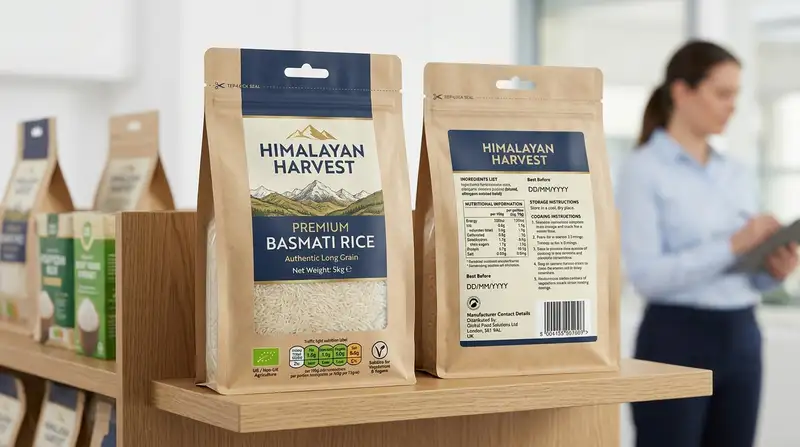
For agricultural importers, FMCG brand distributors, and ethnic supermarket chains placing packaged Indian rice onto shelves across the United Kingdom and the European Union, clearing port border controls at Felixstowe, Rotterdam, or Antwerp is only half the compliance equation. Once cargo clears sanitary checks, the packaging itself becomes subject to intensive regulatory scrutiny by the UK Food Standards Agency (FSA), Trading Standards, and national consumer protection authorities across EU Member States.
Under the European Food Information to Consumers (FIC) Regulation (EU) No 1169/2011 and retained UK legislation, labelling errors represent the single largest cause of commercial product recalls, retail delistings, and distributor fines. While rice is an intrinsically non-allergenic, gluten-free cereal grain, secondary contamination risks in multi-crop milling complexes make allergen management and Precautionary Allergen Labelling (PAL) a critical operational discipline.
Pure milled rice is naturally gluten-free and does not appear on the statutory list of 14 major allergens under EU Regulation (EU) No 1169/2011 and UK legislation. However, if processing or packaging lines handle gluten-containing cereals (such as wheat, barley, or rye) or pulses like soy, mandatory Precautionary Allergen Labelling ('May contain traces of gluten') is required. To legally claim 'Gluten-Free' under Commission Implementing Regulation (EU) No 828/2014, the final packaged rice must test below 20 mg/kg (20 ppm) via validated R5 ELISA tests. Packaged consumer goods must also display a 100g nutritional table ('Big 7'), registered UK/EU Food Business Operator (FBO) addresses, and lot traceability numbers.
Key Statutory Benchmarks for UK & EU Packaged Rice
Table 1: Statutory Labelling Mandates under UK FSA & EU Regulation (EU) No 1169/2011
The comparative matrix below details the statutory requirements enforced on consumer-facing and wholesale packaged rice across British and Continental European markets:
| Labelling Component | EU Regulatory Standard (FIC 1169/2011) | UK FSA Mandate (inc. Natasha's Law) | Compliance Verification Method |
|---|---|---|---|
| Product Denomination | Exact commercial description (e.g. 'Long Grain White Rice') | Clear English food name without deceptive claims | Pre-print artwork compliance audit |
| Net Quantity Declaration | Metric units (g or kg) meeting minimum character heights | Metric units with optional UK imperial equivalent | Calibrated online checkweigher records |
| Durability Date | 'Best before' date format (DD/MM/YYYY or MM/YYYY) | 'Best before' format with clear storage instructions | Accelerated shelf-life and moisture testing |
| Food Business Operator (FBO) | Physical postal address of an EU-established entity | Physical postal address of a UK-established entity | Corporate registrar and entity verification |
| Allergen Declaration / PAL | Precautionary labelling if cross-contact risk is real | Prominent warning under Natasha's Law principles | Quantitative R5 ELISA testing (<20 ppm) |
| Nutritional Declaration (Big 7) | Energy (kJ/kcal), fat, saturates, carbs, sugars, protein, salt per 100g | Identical 100g nutritional matrix in clear tabular format | Accredited ISO 17025 laboratory CoA |
| Batch Code & Traceability | Mandatory lot identification under Directive 2011/91/EU | Mandatory batch identifier for targeted recalls | Mill processing and pallet log tracking |
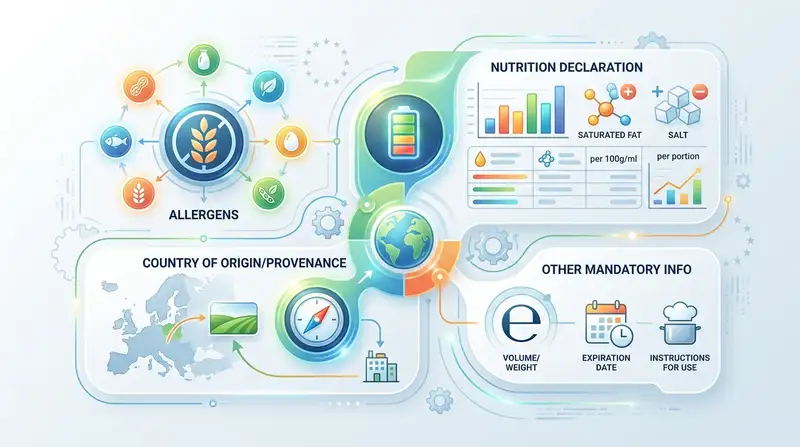
The 5-Stage Allergen Isolation and Verification Protocol
Stage 1 – Dedicated Milling Line Isolation
Cross-contact risk is eliminated at origin. Draba Ventures processes export consignments in Sindhanur on strictly isolated milling lines that do not handle wheat, barley, rye, or soy, preventing air-conveyed dust contamination.
Stage 2 – Multi-Stage Mechanical & Optical Purification
Raw paddy undergoes rotary scalping, high-capacity destoning, multi-deck sieving, and advanced optical camera sorting, removing weed seeds, chaff, and extraneous matter before polishing.
Stage 3 – Quantitative R5 ELISA Gluten Screening
Representative batch composite samples are evaluated in independent ISO 17025 accredited laboratories (such as Eurofins or SGS) using Mendez R5 ELISA protocols, ensuring gluten levels consistently test under 5 ppm (well beneath the statutory 20 ppm ceiling).
Stage 4 – Controlled Packaging & Modified Atmosphere Packing (MAP)
Retail-grade 1kg, 5kg, and 10kg consumer packs are filled and hermetically sealed in positive-pressure clean rooms using food-grade multi-layer BOPP or laminated barrier film, preventing environmental moisture absorption and ingress.
Stage 5 – Export Dossier & Certificate of Analysis Issuance
Every shipment is accompanied by complete documentation: NPPO Phytosanitary Certificate, accredited laboratory nutritional and heavy metal profile, and an official Certificate of Non-Allergenicity / Gluten-Free Status.
Table 2: Draba Ventures 5-Stage Allergen Control vs. Conventional Sourcing
| Production Stage | Responsible Department | Active Contamination Prevention Measure | Official Compliance Output |
|---|---|---|---|
| Stage 1: Line Isolation | Plant Operations Management | Single-grain dedicated facility devoid of gluten grains | Dedicated Facility Audit Report |
| Stage 2: Precision Sorting | Processing & Grading Team | Multi-channel monochromatic and trichromatic sorters | Cleanliness & Purity Inspection Log |
| Stage 3: ELISA Testing | Accredited Third-Party Lab | Quantitative R5 ELISA testing confirming <5 ppm gluten | Independent Eurofins / SGS Test Certificate |
| Stage 4: Sealed Packing | Automated Packaging Unit | Clean-room bagging in hermetic multi-layer barrier films | Packaging Integrity Checklist |
| Stage 5: Documentation | Quality Assurance Export Desk | Consolidated export dossier covering FSA and EU FIC rules | Official Gluten-Free Declaration & COA |
The Cost of Non-Compliance: Retail Delisting & RASFF Alerts: Under UK Trading Standards and EU Rapid Alert System for Food and Feed (RASFF) enforcement, undeclared allergens or misleading 'Gluten-Free' claims trigger mandatory nationwide product recalls. In addition to direct withdrawal costs exceeding £50,000 per incident, major supermarket chains immediately delist non-compliant suppliers. Sourcing from verified single-grain processing mills eliminates this commercial liability entirely.
Strategic Advantages for Private Label & Retail Importers
- Verified Gluten-Free Integrity: Batch-tested below 5 ppm, enabling safe 'Gluten-Free' front-of-pack claims under EU VO 828/2014.
- Turnkey FSA & FIC Compliance: Receive fully drafted, legal rear-panel nutritional matrices and multilingual text ready for supermarket shelf audits.
- Direct Mill Procurement: Eliminate intermediate distributors and broker markups by contracting directly with our Sindhanur processing hub.
- Full Lot Traceability: Continuous backward traceability from individual consumer bags back to audited farming clusters in Karnataka.
Source Retail-Compliant Rice with Verified Allergen Clearance
Request export samples, review accredited Eurofins allergen test reports, or schedule a technical packaging review for UK and EU private label supply.
WhatsApp Export DeskRequest Formal Quotation
Frequently Asked Questions
While pure rice is naturally gluten-free and does not belong to the 14 statutory allergens under EU Regulation (EU) No 1169/2011 and UK law, if the grain is milled or warehoused in facilities handling wheat, barley, or soy, strict FSA regulations mandate Precautionary Allergen Labelling (such as 'May contain traces of gluten').
Under EU Implementing Regulation (EU) No 828/2014 and retained UK regulations, the statement 'Gluten-Free' requires analytical gluten levels below 20 mg/kg (20 ppm). Draba Ventures guarantees this threshold via dedicated rice-only milling lines and accredited R5 ELISA laboratory screening with results below 5 ppm.
Mandatory rear-panel data points include: exact commercial designation (e.g. 'Long Grain White Rice'), net weight in metric units (grams or kilograms), best before durability date, storage instructions, the registered legal address of an EU- or UK-established Food Business Operator (FBO), the statutory 100g nutritional table (energy, fat, saturates, carbohydrates, sugars, protein, salt), and lot or batch code for full traceability.
Draba Ventures delivers export-ready retail and foodservice packaging tailored to private label brand guidelines, complete with FSA- and EU 1169/2011-compliant multilingual typography. We provide accredited laboratory certificates of analysis, nutritional panels, and documented batch traceability, ensuring rapid onboarding with supermarket chains like Tesco, Sainsbury's, and Carrefour.