- 1. The Equatorial Challenge: Humidity & Temperature Dynamics
- 2. Pre-Loading Grain Moisture Desiccation (≤ 12.0%)
- 3. Preventing Container Rain on Maritime Transit Routes
- 4. Residue-Free Phosphine Fumigation & NPPO Protocols
- 5. Barrier Packaging Engineering: Laminated WPP vs Standard Sacks
- 6. Comparative Warehouse Economics in Jurong and Tuas
- 7. Frequently Asked Questions (FAQ)
1. The Equatorial Challenge: Humidity & Temperature Dynamics
Singapore's equatorial climate presents severe physical and biological challenges for dry agricultural commodities. With ambient temperatures consistently hovering between 29°C and 33°C and relative humidity (RH) routinely surpassing 80% across industrial hubs like Jurong, Tuas, and Pandan Loop, milled rice exists in a state of continuous thermodynamic stress. Unless specifically engineered at source, containerized rice shipments absorb ambient water vapor, triggering accelerated lipid oxidation, fungal heating, and dormant insect emergence within weeks of customs clearance.
For commercial rice importers, food distribution enterprises, and institutional buyers supplying supermarket giants such as NTUC FairPrice, Sheng Siong, and Cold Storage, inventory write-offs caused by mold contamination or Sitophilus oryzae (rice weevil) infestations represent devastating margin drains. Preventing these post-harvest losses requires rigorous engineering interventions deployed before the cargo leaves the processing mills in Karnataka.
Pre-Loading Grain Moisture Desiccation: The 12.0% Critical Threshold
Conventional rice milling practices across India and Southeast Asia historically pack non-basmati rice at 14.0% to 15.0% moisture content. While legally permissible under baseline commercial contracts, this moisture level is catastrophic for tropical destinations. At 14.5% moisture and 30°C ambient heat, the water activity (aw) inside the grain reaches 0.70—the exact physiological threshold required for Aspergillus flavus sporulation and enzymatic fat hydrolysis.
Draba Ventures eliminates this biochemical hazard through computer-controlled fluid-bed mechanical desiccation at our milling facilities in Gangavathi and Sindhanur. Every consignment of Sona Masoori, Low GI RNR 15048, and IR-64 white rice is systematically dried to an exact equilibrium moisture content of 12.0% to 12.5%. Starving the grain of free water suppresses microflora metabolism, arrests fungal reproduction, and guarantees biochemical dormancy throughout equatorial storage.
Physical & Chemical Storage Vulnerabilities vs. Draba Ventures Precision Engineering Protocols
| Storage Risk Factor | Equatorial Climate Impact (30°C / 85% RH) | Standard Broker Commodity Handling | Draba Ventures Precision Protocol | Commercial Shelf-Life Outcome |
|---|---|---|---|---|
| Grain Moisture Content | Accelerates mold sporulation, fungal heating, and fat acidity breakdown. | 14.0% to 15.0% moisture (uncalibrated commercial drying). | Multi-stage mechanical desiccation stabilized strictly at 12.0% – 12.5%. | Total suppression of Aspergillus flavus; 24-month stability. |
| Maritime Condensation ('Container Rain') | Dew point drops on container roof during night sea cooling, dripping water onto top bags. | Standard unlined shipping containers without moisture absorbers. | 2,000g high-absorption calcium chloride desiccant poles + PE container liners. | Zero condensation damage; 100% dry arrival at PSA Singapore. |
| Insect Infestation (Sitophilus oryzae) | Tropical heat hatches dormant weevil eggs within 14–21 days in untreated grain. | Superficial surface spraying or unmonitored atmospheric transit. | Closed-loop Aluminium Phosphide (PH3) fumigation (3g/m³ for 120 hrs) + degassing. | 100% mortality across egg, larval, and adult stages; residue < 0.01 ppm. |
| Packaging Moisture Permeability | Atmospheric humidity enters sacks, raising equilibrium moisture above 14.0%. | Single-layer porous woven polypropylene bags (open weave). | 3-ply moisture-barrier laminated BOPP/WPP bags with ultrasonic seal seams. | Hermetic barrier maintains grain moisture in non-air-conditioned warehouses. |
| SFA Statutory Chemical Compliance | SFA border laboratories reject cargo with chemical residue violations. | Inconsistent aeration times; risk of phosphine or pesticide residue hold. | 48-hour mechanical degassing and pre-shipment GC-MS screening. | Instant TradeNet automated clearance; compliant with Singapore Food Regulations. |
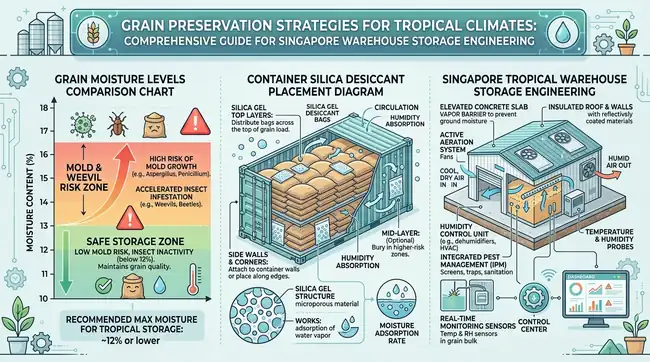
Preventing Maritime Condensation: Container Rain Mitigation on Coromandel Routes
The 4 to 6 day maritime voyage from Chennai Port or Kattupalli to PSA Singapore crosses equatorial waters characterized by drastic diurnal temperature fluctuations. Solar radiation heats the steel exterior of ocean containers to over 50°C during daylight hours, driving internal moisture upward. As ambient temperatures drop sharply at sea after sunset, the container roof cools below the dew point, creating severe internal condensation—a phenomenon known in freight logistics as 'container rain'.
Left unmanaged, condensed water droplets drip directly onto the top tier of stacked rice sacks, causing localized rotting, caking, and rapid aflatoxin development. Draba Ventures neutralizes container condensation through a dual-defense system: every export box is lined with seamless food-grade polyethylene bulkhead liners and fitted with high-capacity calcium chloride desiccant poles. Capable of absorbing over 300% of their dry weight in ambient water vapor, these desiccants permanently bind moisture into a solid gel, ensuring that cargo arrives dry and pristine.
Residue-Free Phosphine Fumigation & NPPO Certification Standards
Weevil control in tropical rice storage is not merely about killing adult insects; it requires eradicating microscopic eggs embedded deep within the endosperm of the grain. Standard contact insecticide sprays fail completely because they cannot penetrate the kernel. When shipments enter warm Singapore storage facilities, ambient temperatures trigger rapid larval development, producing visible infestations within three weeks.
Draba Ventures executes professional Aluminium Phosphide (PH3) gas fumigation inside gas-tight enclosure chambers under the supervision of the National Plant Protection Organization (NPPO). The grain is exposed to a precisely maintained concentration of 3g/m³ of phosphine gas for 120 continuous hours, ensuring complete mortality across all egg, pupal, larval, and adult life stages. Following fumigation, the cargo undergoes forced-air mechanical degassing for 48 hours until gas chromatography confirms chemical residues are below 0.01 mg/kg—far below Singapore Food Agency (SFA) statutory limits.
Barrier Packaging Engineering: Preserving Quality in Singapore Hubs
Standard single-layer woven polypropylene (PP) bags are porous by design, allowing high-humidity Singapore warehouse air to pass directly into the rice stack within 72 hours of palletizing. Draba Ventures bridges this final vulnerability through advanced barrier packaging engineering.
We package export rice in custom-extruded 3-ply Biaxially Oriented Polypropylene (BOPP) laminated bags equipped with internal polyethylene vapor barriers and ultrasonic micro-perforations that allow gas escape during vacuum packaging while completely blocking moisture penetration. For high-end retail brands and foodservice distributors, our automated packaging lines deliver retail packs (1kg, 5kg, 10kg) and 25kg commercial master sacks that withstand ambient humidity in Singapore warehouses for up to two years without degradation.
Comparative Shelf-Life & Warehouse Holding Economics in Singapore (Jurong & Tuas Logistics Parks)
| Warehouse Storage Model | Ambient Environment Specs | Conventional Rice (14.5% Moisture) | Draba Ventures Stabilized Rice (12.0%) | Monthly Holding Economics & Wastage |
|---|---|---|---|---|
| Standard Ambient Warehouse (Jurong / Tuas) | Temp 29–33°C, Relative Humidity 78–88%. | 6–8 weeks before mold spotting and weevil emergence occur. | 12–18 months stable shelf life with zero insect proliferation. | Lowest holding cost ($14–18/pallet/mo); zero inventory write-offs. |
| Dehumidified Ambient Storage (Tuas West) | Temp 28–30°C, RH controlled at 60–65%. | 3–5 months before moisture absorption and fat rancidity develop. | 18–24 months pristine aroma, cooking expansion, and starch integrity. | Moderate holding cost ($22–26/pallet/mo); preserves premium retail quality. |
| Cold Room / Climate-Controlled Chilled | Temp 15–18°C, RH controlled at 50–55%. | 10–12 months, but condensation shock occurs when discharged to retail. | 24+ months optimal preservation; no thermal shock condensation upon dispatch. | Premium cost ($38–48/pallet/mo); Draba rice achieves equivalent ambient stability. |
Procure Tropical-Engineered Rice Consignments from Karnataka
Protect your warehouse margins against tropical humidity and weevil losses with verified ≤ 12.0% moisture desiccation, NPPO fumigation certification, and container desiccant protection.
Request Tropical Packing Specs & CIF Quote Contact Storage Specialists (+91 99165 50010)7. Frequently Asked Questions (FAQ)
Singapore's constant ambient heat (30°C+) and extreme humidity (80%+) create ideal biological incubation conditions. Standard commodity rice shipped at 14.5% moisture contains enough internal water activity to trigger dormant weevil eggs embedded within the kernel and encourage rapid Aspergillus mold growth within 6 to 8 weeks.
Agricultural engineers recommend stabilizing milled rice at an internal moisture content of 12.0% to 12.5% for tropical storage. At or below 12.0% moisture, water activity drops below 0.65 aw, which biologically arrests fungal sporulation, inhibits lipid oxidation, and prevents insect reproductive cycles.
The Singapore Food Agency (SFA) mandates that imported grains be free of live pests and comply with Maximum Residue Limits (MRL). Consignments must carry an official NPPO Phytosanitary Certificate confirming certified pre-shipment fumigation (typically Aluminium Phosphide at 3g/m³ for 120 hours) along with complete post-fumigation degassing to undetectable residue levels (<0.01 mg/kg).
Draba Ventures deploys a multi-layered anti-condensation protocol: (1) drying grain to ≤ 12.5% moisture prior to packing, (2) installing food-grade polyethylene container liners, and (3) placing 2,000g high-absorption calcium chloride desiccant poles inside every 20ft container to permanently capture ambient moisture before it can condense on the container ceiling.
