For B2B rice distributors, institutional food caterers, and supermarket chain procurement teams in Singapore, choosing between Raw White and Parboiled Sona Masoori is fundamentally an exercise in margin optimization and channel alignment. While both variants originate from identical Oryza sativa indica paddy harvested across the fertile Tungabhadra basin in Karnataka, their divergent post-harvest processing pathways create fundamentally distinct commercial yield economics.
Singapore imports over 85% of its non-basmati medium-grain rice from India, with Sona Masoori serving as the benchmark staple for both South Asian culinary establishments and health-conscious households. Navigating port clearance at PSA terminals, adhering to Singapore Food Agency (SFA) maximum residue limits (MRLs), and managing high ambient tropical humidity require grain distributors to understand how thermal gelatinization impacts wholesale storage life, freight bulk density, and end-user kitchen food cost.
Technical Processing: Gelatinization vs. Direct Polish
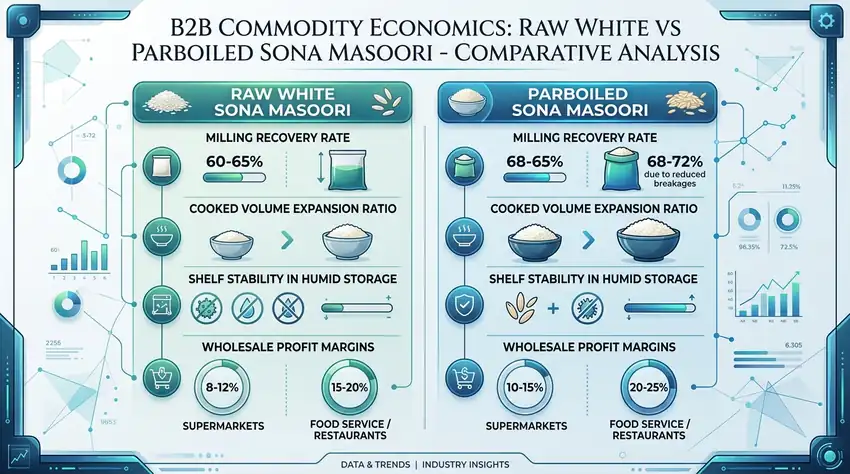
Raw White Sona Masoori undergoes conventional de-husking and abrasive multi-stage whitening directly after mechanical drying. The grain's endosperm starch remains in its native crystalline structure. This yields an exceptionally fragrant, light, and easily digestible rice with rapid hydration during domestic cooking. However, native starch granules remain susceptible to structural fracture during mechanical milling, yielding a head rice recovery rate of approximately 62% to 64%.
In contrast, Parboiled Sona Masoori undergoes a controlled three-phase hydrothermal treatment prior to de-husking: vacuum soaking in warm water, pressurized steam injection, and uniform low-temperature drying. This hydrothermal process gelatinizes the amylose and amylopectin matrix, cementing internal micro-fissures and dissolving nutrient-rich bran oils into the starchy core. As a result, parboiled milling achieves an exceptional head rice recovery rate of 68% to 71%, virtually eliminating broken grains and providing extreme grain hardness during bulk ocean transport from Chennai or Kakinada to PSA Singapore.
Channel Economics: Retail Supermarkets vs. HORECA Food Service
In Singapore's retail grocery ecosystem—dominated by NTUC FairPrice, Sheng Siong, Cold Storage, and ethnic superstores like Mustafa Centre—Raw White Sona Masoori commands a premium consumer price point. Domestic consumers willingly pay between SGD 2.40 and SGD 3.10 per kilogram in 5kg and 10kg poly-woven BOPP retail packaging, prizing its pristine white translucence, soft mouthfeel, and rapid boiling profile. Importers supplying retail channels typically capture a gross wholesale margin of 14% to 18%, supported by brand packaging and supermarket shelf turnover.
Conversely, Singapore's commercial catering and HORECA sector—comprising Little India restaurant conglomerates, banquet kitchens, school cafeterias, and offshore marine catering—operates almost exclusively on Parboiled Sona Masoori packed in heavy-duty 25kg and 50kg polypropylene bags. Commercial kitchens prioritize cooking yield and holding durability over raw appearance. When cooked, Parboiled Sona Masoori achieves an expansion ratio of 3.8x to 4.2x its dry weight, compared to 2.8x to 3.2x for Raw White. Furthermore, parboiled grains maintain complete structural integrity under commercial food warmers and buffet bain-maries (65°C to 80°C) for over 6 hours without clumping or turning into starch slurry.
Table 1: Technical & Milling Specifications: Raw White vs. Parboiled Sona Masoori
| Technical Parameter | Raw White Sona Masoori | Parboiled Sona Masoori | Procurement Impact for Singapore Buyers |
|---|---|---|---|
| Hydrothermal Treatment | None (Direct mechanical milling) | Soaking, pressurized steam & drying | Parboiling infuses micronutrients & hardens grain |
| Head Rice Recovery (Milling) | 62% - 64% whole grain yield | 68% - 71% whole grain yield | Higher parboiled yield lowers baseline mill gate production cost |
| Broken Grain Allowance | < 4.0% sortex clean grade | < 2.0% sortex clean grade | Parboiled reduces transit breakage during handling at PSA Singapore |
| Cooked Expansion Ratio | 2.8x - 3.2x volumetric yield | 3.8x - 4.2x volumetric yield | Commercial kitchens gain 30% more plated portions per dry kg |
| Bain-Marie Holding Stability | Moderate (Softens after 90 mins) | High (Firm texture 6+ hours) | Zero starch weepage in high-volume food service buffets |
| Target Distribution Channel | Retail groceries & supermarkets | HORECA, central kitchens, catering | Enables portfolio segmentation across retail and commercial accounts |
Wholesale Landed Cost Breakdown: CIF Singapore PSA Terminal
Under the ASEAN-India Free Trade Agreement and the Singapore-India Comprehensive Economic Cooperation Agreement (CECA), Indian milled non-basmati rice enters Singapore with 0% statutory customs import tariff. Importers are solely responsible for Singapore Goods and Services Tax (GST) at 9%, SFA trade permit clearance, and PSA terminal port handling fees.
Because Parboiled Sona Masoori exhibits higher grain density, a standard 20-foot full container load (FCL) can be loaded to its maximum legal weight limit of 26 metric tons (1,040 bags of 25kg) without exceeding volumetric cubage. In contrast, lighter Raw White grains often require careful container stowage to prevent moisture migration during the 4-to-6 day ocean passage from Chennai or Kakinada. Sourcing direct from Draba Ventures' automated milling clusters in Karnataka eliminates intermediate export brokerage commissions (USD 18-25 per MT), providing Singapore distributors with substantial margin insulation against fluctuating ocean freight rates.
Table 2: 20ft FCL (26 MT) Landed Wholesale Economics: Raw White vs. Parboiled (SGD)
| Cost & Margin Breakdown | Raw White (26 MT / 1,040 x 25kg) | Parboiled (26 MT / 1,040 x 25kg) | Variance Analysis |
|---|---|---|---|
| Average FOB Load Port (Chennai/Kakinada) | SGD 950 / MT (SGD 24,700 total) | SGD 910 / MT (SGD 23,660 total) | Parboiled FOB ~4.2% lower due to higher milling recovery |
| Ocean Freight & Surcharges (PSA SG) | SGD 28 / MT (SGD 728 total) | SGD 28 / MT (SGD 728 total) | Identical 20ft container liner freight tariff |
| PSA Handling & SFA Permit Inspection | SGD 18 / MT (SGD 468 total) | SGD 18 / MT (SGD 468 total) | Flat statutory port clearance & phytosanitary release fee |
| Effective Landed CIF Singapore Cost | SGD 996 / MT (~SGD 0.996 / kg) | SGD 956 / MT (~SGD 0.956 / kg) | Parboiled landed cost SGD 40/MT cheaper |
| Wholesale Selling Price (Distributor to Client) | SGD 1,180 / MT (SGD 1.18 / kg) | SGD 1,080 / MT (SGD 1.08 / kg) | Raw white commands higher wholesale price in retail packing |
| Gross Distributor Margin (%) | 15.6% gross margin | 11.5% gross margin | Raw white offers higher wholesale margin, Parboiled turns higher volume |
Quality Assurance: SFA Compliance & Moisture Management
Singapore's equatorial climate poses severe storage challenges: ambient relative humidity routinely exceeds 80%, accelerating mould growth, lipolytic rancidity, and weevil infestation if grain moisture is improperly calibrated. Draba Ventures enforces strict post-milling moisture limits of 12.5% to 13.0% for Raw White and 13.0% to 13.5% for Parboiled shipments. Consignments undergo sealed aluminium phosphide fumigation prior to containerization at Indian origin, accompanied by official phytosanitary endorsements.
Every container exported by Draba Ventures carries certified third-party laboratory analysis from SGS or Eurofins, ensuring full compliance with Singapore's Sale of Food Act. This includes testing for heavy metals (Lead <0.2 ppm, Cadmium <0.1 ppm, Inorganic Arsenic <0.2 ppm) and screening against synthetic pesticide residues. Importers receive digital COAs, non-GMO declarations, and mill traceability documentation 72 hours prior to vessel berthing at PSA Singapore.
Source Direct Mill Sona Masoori for Singapore Distribution
Partner with Draba Ventures for containerized CIF Singapore supply of premium Raw White and Parboiled Sona Masoori with laboratory-verified SFA compliance.
Request CIF Singapore Quotation Direct WhatsApp Trade DeskFrequently Asked Questions
Commercial food service operators prefer Parboiled Sona Masoori due to its superior cooking expansion ratio (yielding 3.8x to 4.2x cooked weight versus 2.8x to 3.2x for raw rice) and high structural stability. The gelatinized starch prevents grains from bursting or becoming mushy when held in heated buffet bain-maries for extended dining services.
Because Parboiled Sona Masoori absorbs more water and expands substantially more than raw rice, a commercial kitchen requires approximately 25% to 30% less raw grain by dry weight to prepare the same number of customer portions. This directly reduces raw material cost-per-plate, boosting kitchen operating margins.
Draba Ventures provides flexible packaging tailored to destination channels: 5kg and 10kg premium BOPP bags with barcode printing and handles for retail supermarket shelves, and 25kg or 50kg high-tensile polypropylene (PP) woven bags with food-grade inner liners for institutional food service and wholesale distributors.
No. Under the Singapore-India Comprehensive Economic Cooperation Agreement (CECA), Indian milled rice enters Singapore duty-free (0% import tariff). Importers are only subject to the prevailing Singapore Goods and Services Tax (GST) at 9%, SFA trade permit clearance, and PSA container terminal handling fees.
