Kenya consumes over 1,100,000 MT of rice annually against domestic production of less than 300,000 MT. Indian IR-64 Parboiled Rice (HS 1006.3010, 100% Sortex, 14% max moisture) represents over 70% of Kenya's commercial import volume due to an $8–$15/MT FOB price advantage over Pakistani alternatives. Ocean container transit from Kakinada to Mombasa takes 16–20 days. Statutory 2026 import requirements include: (1) KEBS PVoC Certificate of Conformity via SGS India (2026–2029 cycle), (2) KNRA radiation clearance at Mombasa Port, (3) 2.25% IDF, and (4) 2.0% RDL.
1. Market Structure: Why Indian Rice Dominates East Africa
Kenya's structural rice deficit has widened significantly. With national consumption exceeding 1.1 million metric tonnes per annum and domestic production from irrigation schemes (Mwea, Ahero, Bura) yielding barely 280,000 MT of paddy, the country relies on oceanic imports for more than 75% of its staple requirement. Over the last decade, Indian non-basmati rice has displaced traditional Southeast Asian suppliers, securing a market share exceeding 65% of imported volume.
Three commercial pillars establish India's dominance in Kenya:
- Unmatched FOB Price Competitiveness: Efficient, high-throughput steam and parboiling mills across Andhra Pradesh and the Tungabhadra basin in Karnataka consistently deliver IR-64 parboiled rice at an FOB cost $8 to $15 per metric tonne below Pakistani IRRI-6 and $40/MT below Thai 5% broken.
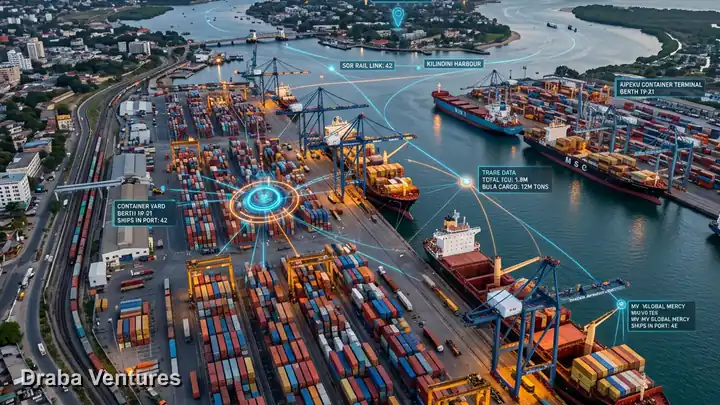
- The Mombasa Regional Gateway Effect: Mombasa is not merely a domestic discharge point; it is the vital logistical entry hub for the entire Northern Corridor. Kenyan commodity houses regularly clear 5-to-20 FCL parcels at Kilindini Harbour for transshipment under customs transit bond to Uganda (Kampala), South Sudan (Juba), Eastern DRC (Goma), and Rwanda (Kigali).
- Superior Culinary Yield & Consumer Preference: Kenyan institutional buyers, wholesalers in Nyamakima (Nairobi) and Kongowea (Mombasa), and commercial caterers strongly favor IR-64 parboiled rice because its gelatinized starch matrix yields high grain elongation, non-sticky cooking characteristics, and excellent hot-holding stability.
| Rice Variety | Target Market Segment | HS Tariff Code | Standard Physical Specifications | Key Commercial Advantage |
|---|---|---|---|---|
| IR-64 Parboiled Rice | Mass Wholesale & Catering | 1006.3010 | 100% Silky Sortex, moisture ≤14%, 5%/15% broken | Lowest CIF landed cost, high cooking expansion |
| RNR Samba Masuri (Raw) | Premium Retail & Diabetic Diets | 1006.3090 | Low Glycemic Index (<55), moisture ≤13%, 2% broken | High-margin retail grocery positioning in Nairobi |
| Sona Masoori (Steam/Raw) | Urban Diaspora & Supermarkets | 1006.3090 | Medium grain, highly aromatic, moisture ≤13% | Preferred staple for Indian diaspora & middle class |
| 1121 Basmati (Steam/Sella) | Luxury HORECA & Festive Retail | 1006.3020 | Extra long grain (8.35mm+), elongation ratio 2.0x | Premium pricing in five-star hotels and formal retail |
2. Statutory Import Regulations: KEBS PVoC & KNRA Screening
Navigating Kenyan customs clearance requires strict adherence to dual mandatory regulatory screening programs introduced and updated for 2026:
KEBS PVoC Contract Reset (2026–2029 Cycle): Under Kenya Bureau of Standards (KEBS) Legal Notice No. 78, every commercial rice container shipped from India must undergo Pre-Export Verification of Conformity (PVoC). Following the February 2026 tender renewal, SGS India serves as the primary accredited surveyor. Testing verifies strict compliance with KS 2295:2022: moisture content ≤14.0%, foreign matter ≤0.1%, and zero tolerance for live stored-grain pests. Consignments passing origin verification receive a digital Certificate of Conformity (CoC). Cargo arriving without a valid CoC is penalized with a 15% CIF penalty surcharge and forced into Destination Inspection (DI) at Kilindini Harbour.
KNRA Radiation Screening (Mandatory Since May 1, 2026): Under statutory directives from the Kenya Nuclear Regulatory Authority (KNRA), all agricultural and mineral containers discharging at Mombasa Port are routed through Portal Radiation Monitors (PRMs) at Berth 20/21 or designated CFS facilities. Cargo must demonstrate background gamma dose rates below 0.20 µSv/h and Cs-137 activity below 10 Bq/kg. Uncertified cargo faces secondary radionuclide spectroscopy holds lasting 4 to 8 business days.
3. Landed Cost Economics: Mombasa CIF to Inland Wholesale
Calculating landed cost accuracy is vital for maintaining wholesale trading margins. In addition to base ocean freight, Kenyan buyers must budget for specific statutory levies and port handling charges:
| Cost / Tariff Component | Statutory Rate / Calculation Basis | Estimated Impact per Metric Tonne (USD) | Responsibility & Payment Mechanism |
|---|---|---|---|
| Mill-Gate FOB (IR-64 Parboiled) | Ex-Mill Kakinada / Chennai | $380 – $410 / MT | Paid by buyer under LC or TT terms to India |
| Ocean Freight (India to Mombasa) | 20ft FCL container liner rate | $45 – $65 / MT ($1,150 – $1,650/TEU) | Included in CIF terms or paid to carrier directly |
| Import Declaration Form (IDF) | 2.25% of CIF Value (min. KES 5,000) | $9.50 – $10.70 / MT | Paid via Kenya TradeNet portal prior to vessel departure |
| Railway Development Levy (RDL) | 2.0% of CIF Value | $8.50 – $9.50 / MT | Collected by KRA at customs entry lodgment |
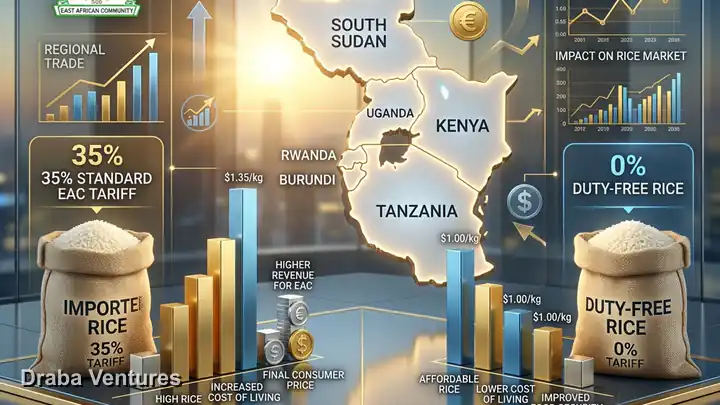
| Customs Import Duty (EAC Tariff) | Common External Tariff (CET) rate | Variable (standard EAC or Duty-Free Gazette) | Payable to KRA Simba/iCMS system |
| KPA Stevedoring & Shore Handling | Kenya Ports Authority tariff | $12.00 – $16.00 / MT | Paid to KPA upon container vessel discharge |
| CFS Transfer & Verification Fees | Container Freight Station handling | $8.00 – $12.00 / MT | Paid to designated CFS operator in Mombasa |
| KNRA Radiation Screening Levy | KNRA statutory inspection fee | $1.50 – $2.50 / MT | Settled through single-window clearance invoice |
| Total Port Landed Cost (Pre-Duty) | Cumulative CIF + Statutory Levies | $465 – $530 / MT | Baseline threshold before domestic road freight |
4. Port Operations & Corridor Logistics: Mombasa to the Hinterland
Container vessels sailing from Kakinada or Chennai transit via Colombo or Salalah, arriving at Kilindini Harbour in 16 to 20 days. Once discharged, cargo follows one of two operational routes:
- Domestic Consumption (Nairobi / Mombasa Markets): Containers are cleared through local CFS facilities in Changamwe or Shimanzi. Bulk parcels are railed via the Standard Gauge Railway (SGR) freight service directly to the Nairobi Inland Container Depot (ICD Embakasi) within 24 hours of customs release, cutting domestic haulage costs by 25% compared to road trucking.
- Cross-Border Northern Corridor Transit: Shipments bound for Uganda, South Sudan, or Eastern DRC exit Mombasa under electronic transit bond (COMESA RCTG). Trucks traverse the 1,150 km corridor to Malaba/Busia border within 4 to 6 days.
To avoid severe storage and demurrage charges, importers must secure a contractual 21-day container detention allowance from the ocean shipping line. Standard 14-day free time is insufficient if KRA selects cargo for physical verification or if KNRA radiation spectroscopy encounters equipment backlogs.
5. Step-by-Step Rice Import Workflow for Kenya
A structured timeline ensures zero-demurrage clearance from initial proforma invoice to warehouse delivery:
| Timeline Milestone | Operational Step | Action by Exporter (India) | Action by Importer (Kenya) |
|---|---|---|---|
| Day -14 to -10 | Contract Finalization & IDF Filing | Issues Proforma Invoice with HS 1006.3010 | Opens TradeNet file, pays 2.25% IDF, secures KEPHIS permit |
| Day -10 to -7 | PVoC Application & Pre-Testing | Lodges RFC with SGS India; tests lot in-house | Provides TradeNet IDF reference number to exporter |
| Day -5 to -3 | Physical Inspection & Stuffing | SGS surveyor inspects bags, tests moisture, seals box | Notifies Mombasa clearing agent of scheduled loading |
| Day -2 to -1 | Phyto & Export Clearance | Obtains NPPO Phytosanitary & Fumigation certs | Confirms Letter of Credit is operational at bank |
| Day 0 | Vessel Departure | Containers loaded on board; draft B/L generated | Monitors ocean carrier container tracking |
| Day +2 to +3 | Document Assembly & Courier | SGS issues CoC; dispatches complete original set by DHL | Clearing agent pre-lodges customs entry in KRA iCMS |
| Day +7 | Pre-Arrival Customs Entry | Provides DHL tracking to buyer; verifies delivery | Clearing agent processes KRA manifest reconciliation |
| Day +17 to +19 | Vessel Discharge at Kilindini | Maintains demurrage monitoring with shipping line | Container passes KNRA scanner; port exit within 72 hours |
6. Quality Preservation: Moisture & Container Sweat Mitigation
During the 20-day equatorial voyage across the Indian Ocean, containers experience severe day-night temperature swings (diurnal thermal cycling). Warm, humid air inside the container condenses against cool steel walls, creating container sweat. If moisture droplets fall onto burlap or single-ply bags, rice kernels absorb water, resulting in yellowing, musty odors, and mold growth.
To ensure 100% pristine arrival, Draba Ventures enforces strict technical packaging standards:
- Strict Moisture Cap: IR-64 parboiled rice is dried to ≤13.2% moisture prior to packing, well below the statutory KEBS maximum of 14.0%, providing an essential absorption safety buffer.
- Virgin Polypropylene Bags: Rice is packed into heavy-duty 85g virgin woven PP bags with micro-perforations that allow gas exchange while blocking moisture liquid ingress.
- Container Desiccant Poles: Every 20ft container is fitted with 4 to 6 high-capacity calcium chloride desiccant poles (absorbing 200% of their weight in moisture) and lined with kraft paper barrier sheets.
7. Turnkey Procurement & Direct-Mill Supply with Draba Ventures
Draba Ventures Private Limited bridges the gap between Indian agricultural heartlands and East African wholesale distributors. Operating ultra-modern Sortex milling plants in Sindhanur, Karnataka—supported by direct ocean logistics desks in Kakinada and Chennai—we provide unmatched commercial reliability:
- Direct Mill-Gate Pricing: By eliminating export brokers and intermediary traders, we supply first-class IR-64, RNR Samba Masuri, and Sona Masoori at genuine mill-direct FOB rates.
- Guaranteed PVoC & KNRA Compliance: Every lot is pre-tested in NABL-accredited laboratories, ensuring guaranteed first-pass SGS CoC issuance and certified zero-radiation compliance under KNRA standards.
- Contractual 21-Day Detention Terms: We partner with premier container carriers (Maersk, MSC, CMA CGM) to include 21 days of container detention free-time directly on the Bill of Lading.
- Full Documentary Coordination via DHL: Complete original shipping documents are dispatched via express courier within 48 hours of vessel sailing, ensuring your clearing agent can pre-lodge customs entries well before vessel arrival.
Frequently Asked Questions
What rice varieties are in highest demand across Kenya from India?
What is the KEBS PVoC program and how does it operate under the 2026–2029 cycle?
What are the rules and timelines for KNRA radiation screening at Mombasa Port?
What is the ocean transit time and optimal shipping route from India to Mombasa?
What are the Import Declaration Form (IDF) and Railway Development Levy (RDL) fees?
Can rice imported into Mombasa be re-exported to Uganda or South Sudan?
Direct Mill Sourcing & Reliable Kenya Delivery
Partner with Draba Ventures for guaranteed compliance in Indian rice exports to East Africa. Benefit from contractual 21-day container detention terms, guaranteed first-pass SGS PVoC certification, certified zero-radiation compliance under KNRA, and direct mill-gate pricing from Karnataka and Andhra Pradesh.
Request Proforma Invoice