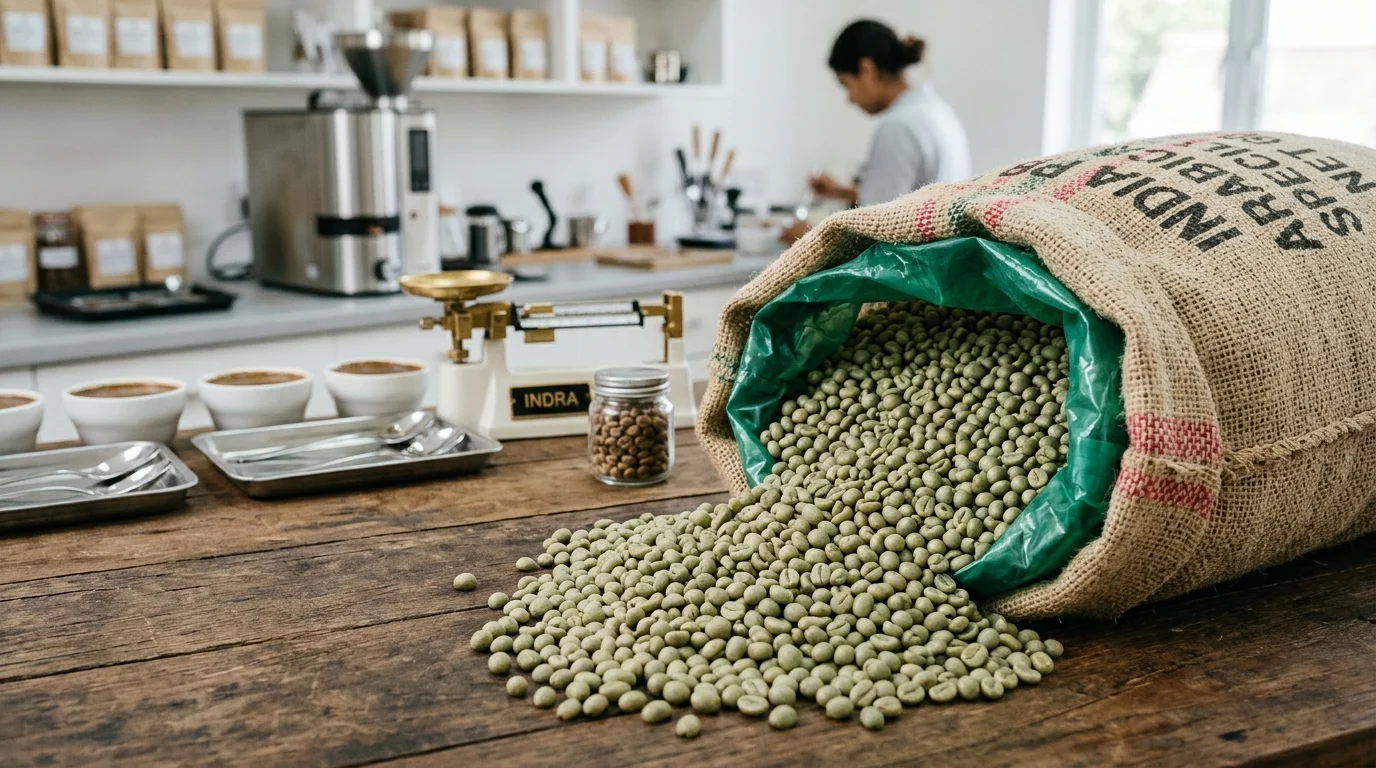
For European and American master roasters, Indian Arabica Peaberry green coffee occupies a coveted niche. Known historically across international trading desks as caracoli in French, caracolillo in Spanish, and Perlbohne in German, this round micro-lot combines concentrated fruit sugars, phosphoric brightness, and an aerodynamically flawless physical shape. Sourcing genuine export-grade Arabica PB demands rigorous separation protocols, microscopic sorting precision, and meticulous moisture barriers to safeguard its unique sensory architecture from the curing mills of Karnataka to destination roasting facilities.
The Anatomy of a Peaberry (PB) Anomaly
Under conventional botanical conditions, the flower of the Coffea arabica bush produces an ovary containing two distinct ovules. When both ovules are successfully pollinated and fertilized, two seeds develop simultaneously, exerting counter-pressure against one another. This bilateral mechanical compression produces the familiar flat-sided coffee bean. In approximately 3% to 6% of cherries (averaging 5% across mature shade-grown plantations), only one of the two ovules is fertilized, or one fails to mature during the primary division stage.
With zero internal competition or lateral physical pressure, the solitary surviving ovule expands freely within the spherical chamber of the cherry carpel. Rather than developing a flattened ventral surface with a straight fissure, it forms an unbroken, rounded, ovoid seed marked by a single, gently curved crease. This morphological distinction carries profound chemical and physical consequences for specialty green buyers:
Nutrient Concentration and Structural Density
Because the parent coffee branch directs its entire vascular pipeline of photosynthesis products, complex sugars, and mineral salts into a single seed rather than splitting nutrients between twins, the Peaberry achieves significantly higher cellular concentration. Bulk density tests on Indian Arabica PB consistently yield 710 to 745 grams per liter, compared to 660 to 690 grams per liter for standard flat Plantation grades. This elevated density translates directly into concentrated soluble solids, amplified malic and citric acidity, and a pronounced, honeyed sweetness in the extraction cup.
Across the shade-grown estates of Chikmagalur, Coorg, and the Biligirirangana (BR) Hills, cool mountain elevations between 1,100 and 1,500 meters further decelerate the ripening cycle of the cherry. This extended maturation period enables the isolated Peaberry seed to synthesize dense sucrose matrices and delicate chlorogenic acid balances, yielding an intensely nuanced cup characterized by blackcurrant, citrus zest, jasmine florality, and a crisp sugarcane finish.
Thermodynamics and Roasting Dynamics
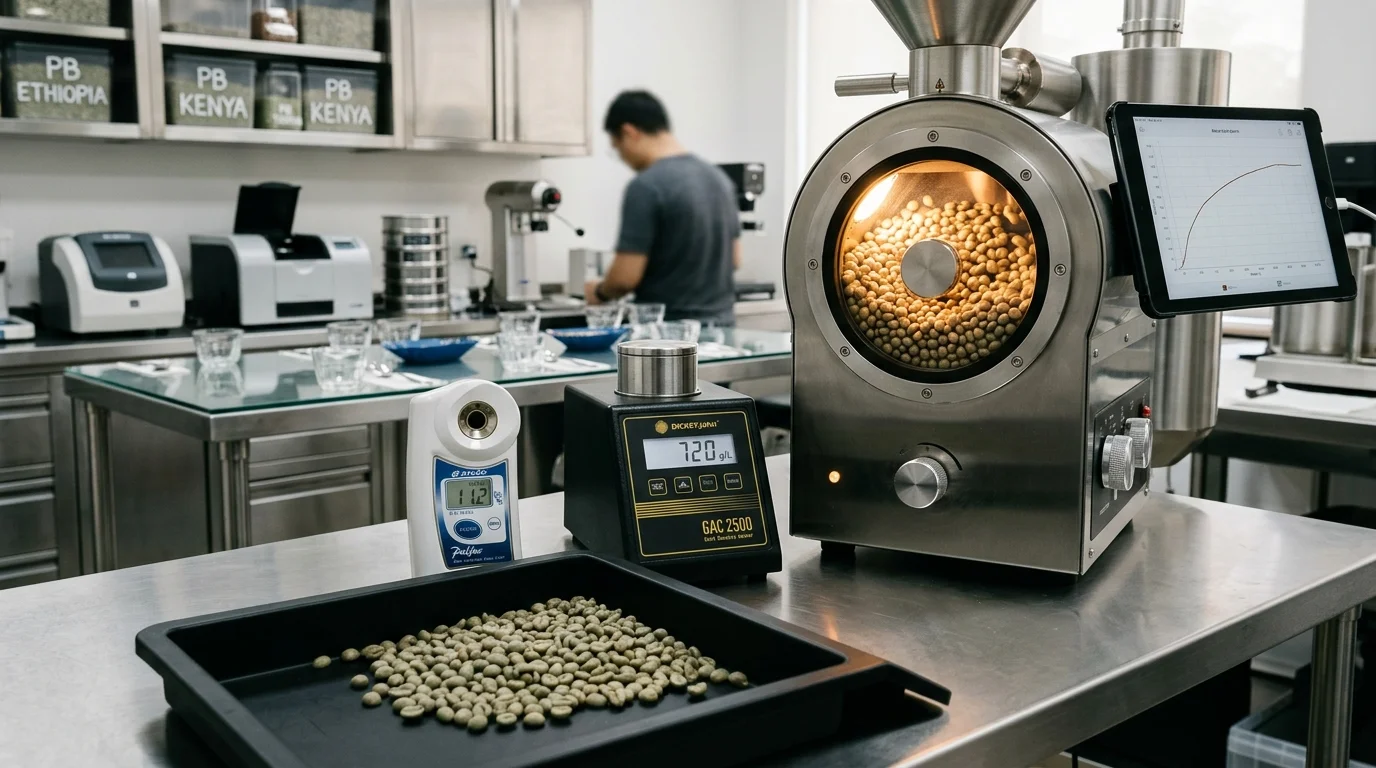
While green bean buyers appreciate Peaberry for its cup concentration, Master Roasters prize it equally for its extraordinary behavior inside the roasting drum. Roasting standard flat-bean coffee requires delicate balance between conductive heat (contact with the heated drum walls) and convective heat (hot airflow passing through the drum). Flat beans possess a distinct planar face that tends to glide along drum paddles and rest momentarily flat against metal surfaces, creating an inherent risk of thermal facing, edge scorching, and tipping during aggressive light-to-medium specialty roast profiles.
The spherical morphology of Indian Arabica Peaberry fundamentally alters drum thermodynamics, offering tangible mechanical advantages during thermal processing:
- Continuous 360-Degree Tumbling Dynamics: Because Peaberry seeds lack flat planar surfaces, they do not slide or rest against hot iron. Instead, they roll freely in continuous, fluid trajectories through convective airflow channels, achieving exceptionally even heat absorption across their entire outer surface.
- Convective Dominance in Heat Transfer: The spherical surface area maximizes boundary layer convective heat transfer, allowing roasters to apply higher burner energy or increased air volume without scorching the delicate outer cellulose layers.
- Steep, Controlled Rate-of-Rise (RoR): Due to elevated core density (720+ g/L), Arabica PB absorbs thermal energy predictably. Roasters can execute a steep initial charging curve without baking the core, transitioning into a vigorous, explosive First Crack where moisture vapor exits symmetrically from the seed center.
- Color Uniformity Across Light Specialty Profiles: In modern Nordic and light-roast specialty styles, where bean development must be achieved in under 9 minutes with minimal roast tint, Arabica PB delivers flawless center-cut development and zero surface scorching artifacts.
| Physical Specification | Coffee Board Baseline Standard (Arabica PB) | Draba Ventures Export Standard |
|---|---|---|
| Screen Size (Mesh) | Slotted screen 14 (5.5 mm round slot) | Slotted Screens 14/15 (Min. 92% retention) |
| Flat Bean Contamination | Max. 3.0% by weight | Max. 0.8% strict limit |
| Defect Garbling (Blacks/Broken) | Max. 2.0% visual garbling | <0.5% (VIS/NIR Sortex Cleaned) |
| Hyperspectral Optical Sorting | Not specified / manual only | 94.63% Sortex Optical Accuracy |
| Internal Moisture Level | Max. 12.0% | 10.5% - 11.5% Strict Target |
| Bulk Density | 680 - 700 g/L baseline | 715 - 745 g/L High-Density Core |
| Packaging Standard | Standard 60kg single jute bag | 60kg Jute + Multi-layer GrainPro Hermetic Liner |
Quality Assurance and Optical Defect Extraction
Isolating genuine Peaberry lots from standard commercial Arabica runs requires extreme mechanical discipline at the primary dry mill. Standard vibrating shaker tables with round perforation screens cannot effectively differentiate round peaberries from flat beans of similar weight. Instead, curing mills must utilize specialized slotted perforated cylinders, whose elongated perforations allow flat-sided beans to pass horizontally through while retaining genuine round Peaberries on the upper deck.
Mechanical screen sizing alone, however, cannot detect internal defects, color irregularities, or insect damage. To meet the exacting thresholds of specialty roasters in Germany, Scandinavia, and North America, Draba Ventures runs all Arabica PB micro-lots through advanced VIS/NIR Hyperspectral Imaging (HSI) Sortex machinery, achieving 94.63% optical sorting accuracy.
This automated optical sorting system inspects every single Peaberry seed in freefall across visible and near-infrared spectral wavelengths. The machine's high-speed pneumatic ejectors instantly eliminate sour or fermented seeds, insect-punctured beans (berry borer damage), cracked or chipped pieces, and deformed 'elephant' ear fragments. By stripping out physical and chemical defects that would otherwise generate bitter, astringent, or muddy cup profiles, Draba Ventures guarantees an exceptionally clean, bright, and reproducible specialty lot.
Moisture Control and Maritime Security
Specialty green coffee is living organic matter, and the dense, concentrated cellular structure of Arabica Peaberry makes it especially vulnerable during ocean freight transit. As containers travel from Indian ports such as New Mangalore (NMPA) or Cochin across equatorial waters toward European and American hubs, ambient temperature fluctuations inside metal shipping boxes can swing from 18 degrees Celsius to over 48 degrees Celsius. If internal moisture is unmanaged, cargo sweat condenses on container ceilings, triggering catastrophic mold colonization and Ochratoxin A (OTA) mycotoxin contamination.
To eliminate maritime risks and ensure zero loss of delicate volatile acids during multi-week ocean journeys, Draba Ventures enforces an uncompromising supply-chain protocol:
- Strict Moisture Pre-Conditioning: Every lot is sampled and tested across multi-frequency dielectric moisture analyzers to guarantee internal moisture sits precisely between 10.5% and 11.5%, strictly below the legal 12.0% threshold.
- Multi-Layer GrainPro Hermetic Barriers: Rather than packaging in unlined porous jute, all Peaberry lots are vacuum-choked inside multi-layer hermetic GrainPro liners before being sewn into export-grade 60kg natural jute bags. This barrier blocks ambient vapor entry, stabilizes internal water activity (aW < 0.60), and arrests cellular lipid degradation.
- Container Desiccant Pole Fortification: Shipping containers are lined with industrial calcium chloride desiccant poles suspended along internal walls, adsorbing any trapped atmospheric humidity and preventing condensation drops.
- Laboratory Purity Documentation: Each export consignment is accompanied by official Coffee Board of India grading certificates, APEDA export clearances, and Eurofins multi-residue pesticide and Ochratoxin A test reports confirming complete EU and FDA compliance.
Frequently Asked Questions (FAQ)
Direct Sourcing Inquiries
Connect directly with Draba Ventures' specialty coffee export desk for spot micro-lot offers, FOB Mangalore / CIF destination pricing, and 250g Pre-Shipment Samples (PSS) of genuine Indian Arabica Peaberry.
