- 1. Singapore's Dual Regulatory Architecture: SFA & Enterprise Singapore
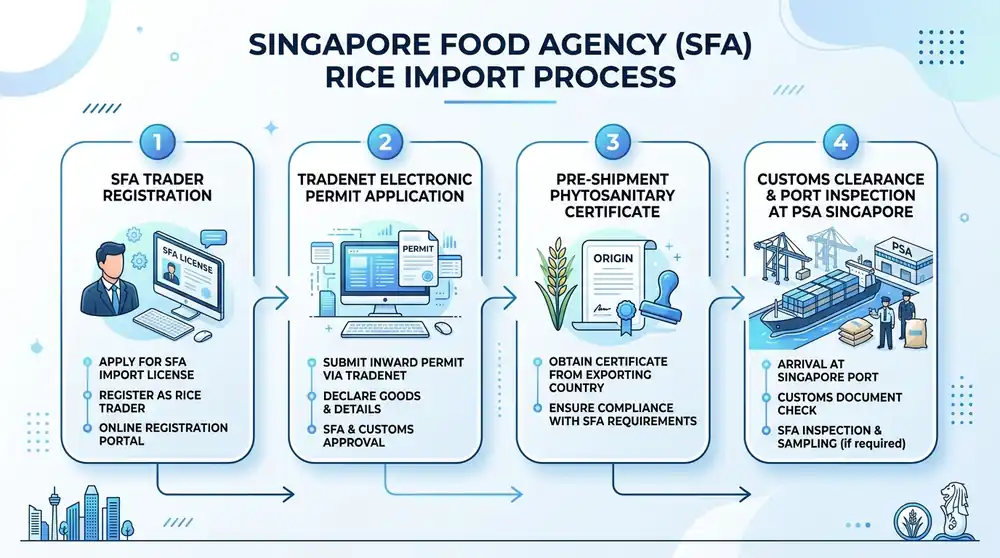
- 2. Step-by-Step Licensure: ACRA Registration, SFA Account & TradeNet
- 3. The Rice Stockpile Scheme (RSS): Buffer Stock Mandates for White Rice
- 4. Mandatory Pre-Shipment Compliance & Indian Export Certification
- 5. SFA Port Clearance Protocols at PSA Singapore: Inspection & Release
- 6. Direct Mill Procurement & Flawless Compliance with Draba Ventures
- 7. Frequently Asked Questions (FAQ)
1. Singapore's Dual Regulatory Architecture: SFA & Enterprise Singapore
Importing commercial rice consignments into Singapore demands adherence to one of the world's most disciplined food biosecurity and supply security architectures. The Singapore Food Agency (SFA), established under the Ministry of Sustainability and the Environment, strictly administers the Sale of Food Act (Cap. 283) and the Food Regulations to safeguard the island nation's food supply. Any commercial business intending to import Indian non-basmati, Sona Masoori, RNR 15048, or Basmati rice must operate with full regulatory licensure.
Navigating this compliance landscape involves not only biological and chemical food safety standards overseen by SFA, but also economic stockpiling mandates governed by Enterprise Singapore (ESG) under the Price Control Act. For procurement directors at supermarket chains like NTUC FairPrice and Sheng Siong, ethnic food distributors in Little India, and industrial central kitchens, procedural oversights or documentation discrepancies can result in instant TradeNet permit rejections, cargo quarantine, or catastrophic PSA demurrage charges.
Step-by-Step Licensure: ACRA Registration, SFA Trader Account & TradeNet
Before an importer can place a commercial purchase order or book freight from Indian ports like Chennai or Krishnapatnam, three sequential institutional registrations must be secured in Singapore. First, the importing enterprise must be registered with the Accounting and Corporate Regulatory Authority (ACRA) and obtain an active Unique Entity Number (UEN). The company's primary or secondary SSIC code must formally reflect wholesale trade in grains, rice, or general food products.
Second, the entity must activate its Customs Account with Singapore Customs via TradeNet, appointing authorized declaring agents or registering internal declarations personnel. Third, the company must apply for an SFA Trader Registration / License for Food Import via GoBusiness. The SFA assigns a dedicated Trader Code linked to the company's UEN, establishing legal accountability for the biosecurity and traceability of every incoming grain lot.
Statutory Licensure & Regulatory Clearance Framework: SFA vs. Enterprise Singapore vs. TradeNet
| Regulatory Domain | Statutory Authority & Legislation | Mandatory Permit / License | Operational Timeline | Draba Ventures Verification & Compliance Protocol |
|---|---|---|---|---|
| Corporate Trader Eligibility | ACRA & SFA (Sale of Food Act Cap. 283) | SFA Registration for Food Importers (UEN-linked) | Annual renewal; instant GoBusiness processing | Verification of buyer UEN & SFA credentials prior to proforma contracting. |
| Customs Inward Declarations | Singapore Customs (Customs Act) & TradeNet | TradeNet Inward Cargo Clearance Permit (CCP) | Lodged 48 to 72 hours prior to vessel berthing | Early release of final commercial invoice, packing list, and non-negotiable B/L. |
| National Food Security Buffer | Enterprise Singapore (Price Control Rice Order) | Designated Rice Importer License (RSS Mandate) | Continuous; 2-month rolling physical warehouse stock | Guaranteed steady-state monthly shipping cycles to prevent warehouse buffer depletion. |
| Phytosanitary & Quarantine Biosecurity | SFA Plant Science & Biosecurity / NPPO India | Official Indian NPPO Phytosanitary Certificate | Issued post-fumigation prior to port departure | 100% inspection by Indian quarantine officers; zero-weed and zero-live-pest guarantee. |
| Chemical Contaminant Ceilings | SFA Food Regulations (10th & 11th Schedules) | NABL / ILAC Batch Certificate of Analysis (CoA) | Tested 3-5 days prior to mill dispatch | Full panel screening for heavy metals (As <= 0.2 ppm) and pesticide MRLs via Eurofins/SGS. |
The Rice Stockpile Scheme (RSS): Buffer Stock Mandates for White Rice
A critical legal distinction that every Singapore rice buyer must grasp is the Rice Stockpile Scheme (RSS). Administered by Enterprise Singapore (ESG) under the Price Control (Rice) Order, the RSS is designed to guarantee national food security and price stability. Under this regulation, registered importers of white rice—including non-basmati milled rice, parboiled rice, and fragrant rice—are legally obligated to participate in the stockpile.
Under standard RSS rules, licensed white rice importers must store a designated buffer quantity—typically equivalent to twice their monthly import quota—in government-approved, climate-controlled licensed warehouses (such as designated logistics centers in Jurong or Senoko). Basmati rice is currently exempted from the RSS stockpile obligation, but Sona Masoori, RNR 15048, and IR-64 white rice fall under the stockpile framework. Importers must carefully factor monthly warehouse storage fees, pallet handling, and stock rotation into their landed cost calculations.
Mandatory Pre-Shipment Compliance & Indian Export Certification
SFA border control operates on a rigorous risk-based inspection matrix. When cargo arrives at PSA Singapore, TradeNet electronically validates incoming shipment data against risk profiles. If documentary anomalies exist or test parameters are absent, customs automatically flags the container for inspection hold. To ensure immediate cargo clearance, Indian mill-direct suppliers must provide an airtight pre-shipment documentation suite.
Draba Ventures executes a zero-defect documentation protocol. Every 20ft container consignment dispatched from our Karnataka milling facilities is accompanied by an authentic Phytosanitary Certificate issued by the National Plant Protection Organization (NPPO) of India, verifying closed-loop phosphine fumigation (3g/m3 for 120 hours). Furthermore, we supply comprehensive Certificates of Analysis from ISO/IEC 17025 accredited testing laboratories (Eurofins, SGS, or Vimta) verifying compliance with SFA heavy metal thresholds (Inorganic Arsenic <= 0.2 ppm, Cadmium <= 0.1 ppm, Lead <= 0.2 ppm) and strict pesticide Maximum Residue Limits (MRLs).
Mandatory Export-Import Documentation Checklist & Port Clearance Risk Matrix
| Document Instrument | Issuing Authority | Key Mandatory Data Fields | Primary Discrepancy Risk | Draba Ventures Quality Assurance Protocol |
|---|---|---|---|---|
| Phytosanitary Certificate | NPPO India (Directorate of Plant Quarantine) | Botanical name (Oryza sativa), container numbers, fumigation dosage & temperature | Fumigation date later than B/L boarding date; incorrect botanical nomenclature. | NPPO inspection coordinated directly at port of loading; 100% pre-vessel issuance. |
| Certificate of Analysis (CoA) | NABL / ILAC Accredited Lab (Eurofins / SGS) | Heavy metals (As, Cd, Pb, Hg), multi-pesticide screen (Tricyclazole, Chlorpyrifos), aflatoxins | Missing test parameters specified in SFA 10th Schedule; obsolete test methodologies. | Standardized Singapore test template matching SFA laboratory protocol limits. |
| Clean on Board Ocean Bill of Lading | Ocean Shipping Line (PSA discharge port) | Consignee ACRA UEN, matching container & seal numbers, 'Shipped on Board' notation | Typographical error in container prefix; mismatched gross weight against packing list. | Three-tier document verification against physical container seals prior to surrender. |
| Commercial Invoice & Packing List | Draba Ventures Private Limited (Exporter) | HS Code (1006.30.90 / 1006.10), FOB/CIF breakdown, bag counts, tare vs net weight | Value discrepancies across TradeNet declaration; incorrect metric net weights. | Direct ERP generation matching exact TradeNet declaration parameters. |
| Certificate of Origin (CoO) | APEDA / Indian Chamber of Commerce | Exporter IEC, Chamber seal, country of origin certification, vessel voyage details | Late submission after ship arrival leading to import clearance bottlenecks. | Courier dispatch of originals + express electronic digital copies upon vessel departure. |
Upon vessel arrival at PSA Singapore (Brani, Keppel, or Pasir Panjang Terminals), the TradeNet system cross-examines the inward permit with shipping manifests. SFA assigns each shipment into one of three regulatory channels: Green (immediate automated clearance), Amber (document verification hold), or Red (physical inspection and laboratory sampling hold). Consignments originating from unknown traders or lacking verified pre-shipment CoAs face high probabilities of Red-channel routing.
If a container is flagged for physical sampling, SFA inspectors draw representative grain samples for testing at the National Centre for Food Science (NCFS). The container remains grounded at the port terminal, accumulating PSA storage and container demurrage charges of SGD 120 to SGD 280 per TEU per day. By presenting pre-authenticated, accredited third-party lab panels and verifiable digital traceability from Draba Ventures, Singaporean importers consistently secure rapid Green-channel clearance, eliminating demurrage overhead entirely.
Direct Mill Procurement & Flawless Compliance with Draba Ventures
Sourcing rice directly from Draba Ventures eliminates the layers of unvetted aggregators, commission brokers, and paperwork discrepancies that routinely trigger customs friction in Singapore. Operating directly out of the Tungabhadra agricultural basin in Karnataka, Draba Ventures bridges certified farming clusters with Singapore's premier food importers.
Every export container of Sona Masoori, RNR 15048 Low-GI, or IR-64 is processed through automated Sortex optical cleaning, vacuum-sealed or multi-wall poly-lined to prevent moisture condensation during transit, and certified to SFA specifications before departure. Whether you operate an ethnic supermarket in Serangoon, distribute to HORECA caterers in Jurong, or manage national supermarket house brands, Draba Ventures delivers absolute regulatory certainty, direct mill-gate pricing, and end-to-end logistic execution.
Import Indian Rice into Singapore with 100% SFA Compliance
Eliminate customs delays, PSA demurrage risks, and laboratory rejections. Partner with Draba Ventures for certified Sona Masoori, RNR 15048, and non-basmati rice backed by flawless SFA documentation and mill-direct FOB/CIF pricing.
Request SFA Compliance Dossier & CIF Quote Inquire via WhatsApp (+91 99165 50010)7. Frequently Asked Questions (FAQ)
To legally import rice into Singapore, an enterprise must: (1) Maintain an active ACRA corporate registration with a valid UEN; (2) Activate a Singapore Customs account via TradeNet; (3) Secure an SFA Trader Registration / License for Food Import via GoBusiness; and (4) Obtain an approved TradeNet Inward Cargo Clearance Permit prior to each shipment's arrival.
The Rice Stockpile Scheme (RSS), administered by Enterprise Singapore under the Price Control (Rice) Order, mandates that licensed white rice importers maintain a strategic physical buffer stock (typically 2 months of import volume) in approved climate-controlled warehouses to ensure national food security. While milled non-basmati white rice like Sona Masoori and RNR 15048 is subject to the RSS, Basmati rice is currently exempt.
The most frequent causes of TradeNet permit delays and SFA cargo holds include: (1) Discrepancies between container numbers on the Bill of Lading and the TradeNet application; (2) Incomplete or missing Phytosanitary Certificates from the exporting country; (3) Certificate of Analysis lacking required SFA heavy metal or pesticide MRL screens; and (4) Mismatched product descriptions or incorrect HS codes (e.g., confusing 1006.30 milled rice with broken rice).
Draba Ventures provides an airtight pre-shipment export compliance package: Official NPPO Indian Phytosanitary Certificates with verified phosphine fumigation logs, ISO/IEC 17025 accredited laboratory CoAs covering all SFA 10th/11th Schedule contaminant thresholds, exact HS code documentation, and express digital documentation released 72 hours before vessel arrival at PSA Singapore.
