- 1. Singapore's National War on Diabetes & Dietary Shift
- 2. The Glycemic Index Science: RNR 15048 (GI 51.5) vs Regular Rice
- 3. The Brown Rice Texture Barrier & RNR 15048 Drop-In Solution
- 4. Health Promotion Board (HPB) Healthier Choice Alignment
- 5. Supermarket Category Velocity & Margin Expansion
- 6. Direct Mill Procurement with Draba Ventures
- 7. Frequently Asked Questions (FAQ)
1. Singapore's National War on Diabetes & Dietary Shift
Singapore's Ministry of Health (MOH) and Health Promotion Board (HPB) have declared diabetes a national public health emergency. With nearly 440,000 citizens currently living with diabetes and projections indicating that one in three Singaporeans will develop the chronic disease by 2050, public health authorities are aggressively targeting refined carbohydrates. Because white rice is the foundational calorie source for over 80% of local meals, institutional health campaigns have placed staple grains under unprecedented scrutiny.
For supermarket category managers at NTUC FairPrice, Sheng Siong, Cold Storage, and Giant, this policy shift creates an acute commercial dilemma: regular polished white rice drives massive footfall but contradicts national health advisories, while conventional brown rice faces stubborn consumer resistance due to its chewy texture and altered taste. Sourcing a grain that satisfies clinical dietary benchmarks while maintaining authentic white rice culinary performance is now the primary objective in grain procurement.
The Glycemic Index Science: RNR 15048 (GI 51.5) vs Regular Rice Varieties
The Glycemic Index (GI) quantifies how rapidly carbohydrate foods convert into blood glucose following consumption. Standard polished Jasmine and Hom Mali white rice varieties possess a high GI between 75 and 82, generating swift spikes in postprandial blood sugar that overwhelm insulin response. Even unpolished brown rice typically registers a moderate GI rating between 55 and 62.
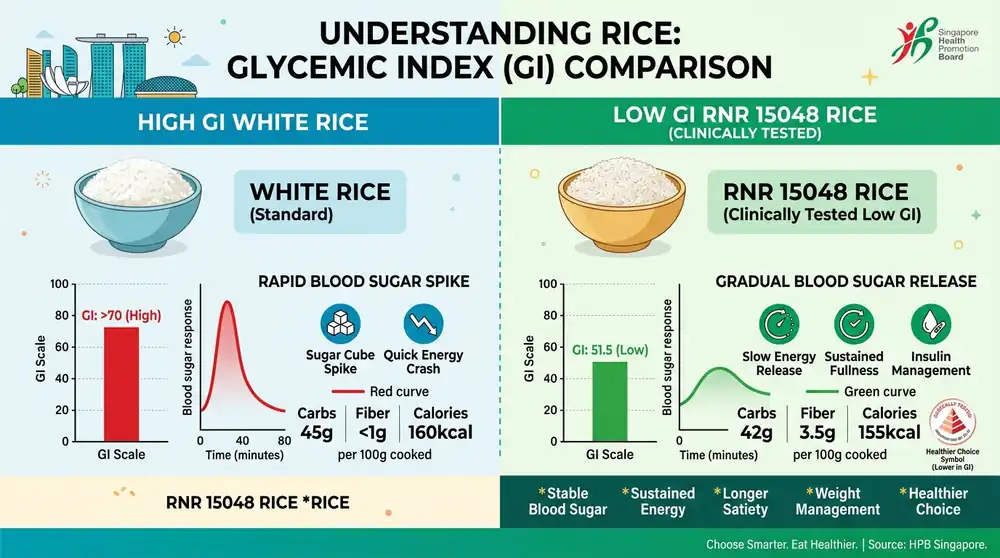
RNR 15048—popularly known as Telangana Sona—is an agricultural breakthrough developed by Professor Jayashankar Telangana State Agricultural University (PJTSAU) and clinically validated by the National Institute of Nutrition (NIN) in Hyderabad. Testing with a Glycemic Index of exactly 51.5, it falls squarely within the internationally certified Low-GI category (GI ≤ 55). Its elevated amylose content (28.2%) forms a tight crystalline starch matrix that resists rapid digestive enzyme hydrolysis, yielding a steady, sustained release of glucose into the bloodstream.
Clinical Nutritional Profile & Glycemic Comparison: RNR 15048 vs Commercial Rice Varieties
| Rice Variety / Commercial Grade | Clinically Validated Glycemic Index (GI) | Amylose Content (%) | Postprandial Blood Glucose Impact | Singapore Culinary Compatibility |
|---|---|---|---|---|
| RNR 15048 (Telangana Sona) | 51.5 (Certified Low-GI, NIN / PJTSAU) | 27.8% – 28.5% (High Amylose) | Gradual sustained glucose release; zero insulin spike. | 100% white rice texture; perfect for Chicken Rice and Biryani. |
| Thai Hom Mali / Jasmine White Rice | 75 – 82 (High-GI) | 12.0% – 16.0% (Low Amylose) | Rapid glucose surge; elevated glycemic load. | Traditional soft fragrant grain; high metabolic diabetes risk. |
| Long-Grain White Rice (IR-64) | 68 – 74 (Medium-High GI) | 22.0% – 24.0% (Moderate Amylose) | Moderate-to-high postprandial insulin spike. | Standard commercial food service staple; lacking health accreditation. |
| Commercial Brown / Cargo Rice | 55 – 62 (Medium-Low GI) | 18.0% – 22.0% (Moderate Amylose) | Moderate glucose rise; slowed by bran fiber. | Low consumer adoption; rough mouthfeel alters heritage dishes. |
| Parboiled Sona Masoori | 58 – 64 (Medium-GI) | 24.0% – 26.0% (Retrograded Starch) | Lower insulin surge than raw polished rice. | Favored in South Indian cuisine; distinct gelatinized parboiled flavor. |
The Brown Rice Texture Barrier & RNR 15048 Drop-In Culinary Solution
For decades, Singapore's dietary initiatives encouraged consumers to switch to brown rice. While nutritionally sound, brown rice encountered severe resistance across multi-generational households and commercial foodservice venues. Singapore's signature heritage dishes—Hainanese Chicken Rice, Nasi Lemak, and Dum Biryani—rely fundamentally on the ability of white rice grains to absorb seasoned broths, coconut milk, and infused oils without developing a heavy, bran-like texture.
RNR 15048 solves this consumer adoption barrier completely. Because it is a fully milled, polished white grain, it looks, cooks, and feels identical to premium Sona Masoori. It expands uniformly upon cooking, absorbs marinades without clumping, and presents a neutral, tender mouthfeel. It serves as a seamless 'drop-in' replacement: families and restaurant diners enjoy authentic culinary heritage while effortlessly consuming a clinically validated Low-GI meal.
Health Promotion Board (HPB) Healthier Choice Alignment
Singapore's Healthier Choice Symbol (HCS) is Asia's most recognized front-of-pack nutritional label, influencing purchasing decisions for over 70% of grocery shoppers. The Health Promotion Board has expanded the HCS framework to incentivize low-glycemic staples that support long-term metabolic control.
Draba Ventures delivers RNR 15048 consignments accompanied by comprehensive clinical verification documentation, including ISO/IEC 17025 accredited laboratory assays detailing amylose content, proximate nutritional analysis, and clinical GI determination. Supermarket house brands and commercial grain packers utilize these analytical dossiers to secure accelerated HPB Healthier Choice Symbol authorization, providing immediate consumer trust on retail shelves.
Supermarket Retail Velocity & Procurement Economics: White Rice vs. Low-GI RNR 15048 in Singapore
| Retail Metric / Operational Parameter | Standard Imported White Rice | Organic Brown Rice Alternative | RNR 15048 Low-GI Rice (Draba Ventures) | Supermarket Category Impact |
|---|---|---|---|---|
| Healthier Choice Symbol (HCS) Eligibility | Ineligible (fails carbohydrate and whole-grain guidelines). | Eligible under 100% whole-grain criteria. | Eligible under HPB Low-GI Carbohydrate Criteria. | RNR 15048 captures HCS badge while offering white rice visual appeal. |
| Consumer Repurchase Rate & Household Retention | High volume, but facing declining health sentiment. | 22% – 28% repeat purchase rate (household mouthfeel resistance). | 76% – 84% repeat purchase rate (identical mouthfeel to white rice). | Eliminates slow-moving inventory and customer attrition. |
| Gross Margin Contribution (Retail / Distributor) | 8% – 12% (highly commoditized price-sensitive staple). | 18% – 24% (niche volume, slow inventory turnover). | 24% – 32% (wellness-oriented premium staple with mass volume). | Substantially expands supermarket gross margin per shelf foot. |
| Foodservice Drop-In Versatility (HORECA / Hawkers) | Universal default for food courts and catering. | Incompatible with Hainanese Chicken Rice broth absorption. | Flawless absorption of chicken broth, coconut milk, and spices. | Opens institutional supply contracts to Singapore food courts and hospitals. |
Direct Mill Procurement of Certified RNR 15048 with Draba Ventures
The global commercial success of RNR 15048 has unfortunately led to widespread varietal adulteration in commodity trading markets. Unscrupulous middlemen frequently blend authentic RNR 15048 with high-GI BPT 5204 or hybrid long-grain paddy, compromising the clinical GI integrity of the shipment.
Draba Ventures guarantees 100% genetic varietal purity. We source paddy directly from contracted grower clusters in the Tungabhadra river belt of Raichur and Ballari. Every batch undergoes seed-lot traceability, automated optical color sorting, and DNA varietal authentication. Packed in moisture-barrier 5kg, 10kg, and 25kg bags with pre-shipment SGS laboratory certification, Draba Ventures provides Singaporean supermarkets and distributors with uncompromised clinical quality at competitive mill-direct FOB and CIF rates.
Source Certified Low-GI RNR 15048 Directly from Karnataka Mills
Capitalize on Singapore's health revolution with clinically verified RNR 15048 (GI 51.5), genetic purity certification, competitive mill-gate FOB/CIF rates, and custom retail packaging.
Request RNR 15048 Lab Panel & CIF Quote Inquire via WhatsApp (+91 99165 50010)7. Frequently Asked Questions (FAQ)
RNR 15048 (Telangana Sona) is a specialized non-basmati rice variety clinically validated by the National Institute of Nutrition (NIN) with a Glycemic Index of 51.5. Its high amylose content (approx. 28%) forms a resistant starch matrix that digests slowly, releasing glucose gradually and qualifying it as a certified Low-GI food (GI ≤ 55).
Under Singapore's national 'War on Diabetes', the Ministry of Health and HPB are targeting high-GI refined carbohydrates. Traditional white rice has a GI between 75 and 82, contributing heavily to blood sugar spikes. Low-GI rice like RNR 15048 provides an effective population-level dietary intervention to reduce diabetes incidence without changing consumer eating habits.
Unlike brown rice, which has a fibrous bran layer that resists broth absorption, RNR 15048 is a polished white grain that cooks, expands, and absorbs aromatics exactly like premium white rice. It provides a flawless drop-in replacement for Hainanese Chicken Rice, Nasi Lemak, and Biryani while maintaining Low-GI health benefits.
Draba Ventures provides full batch documentation with every container shipment, including PJTSAU-certified varietal traceability, NABL/SGS Certificate of Analysis verifying Glycemic Index and amylose percentages, and multi-residue pesticide screening confirming 100% compliance with Singapore Food Agency (SFA) tolerances.
