- 1. Singapore Food Agency (SFA) Statutory Framework
- 2. Heavy Metal Limits: Arsenic, Cadmium, Lead & Mercury
- 3. Mycotoxin & Aflatoxin Controls in Maritime Transit
- 4. Pesticide Maximum Residue Limits (MRL) for Indian Varieties
- 5. Pre-Shipment Laboratory Verification vs SFA Border Screening
- 6. Risk-Free Procurement with Draba Ventures
- 7. Frequently Asked Questions (FAQ)
1. Singapore Food Agency (SFA) Statutory Framework
Singapore maintains one of the world's most exacting statutory food safety architectures. Under the Sale of Food Act (Chapter 283) and the Singapore Food Regulations, the Singapore Food Agency (SFA) enforces stringent limits on agrochemical residues, heavy metals, and fungal mycotoxins across all imported grains. For commercial rice importers, food distributors, and institutional supermarket chains supplying NTUC FairPrice, Sheng Siong, and Cold Storage, ensuring that every container strictly complies with SFA parameters is not merely an operational goal—it is a non-negotiable statutory requirement.
Non-compliant shipments arriving at PSA Singapore or Jurong Port face immediate enforcement action: cargo seizure, mandatory fumigation, re-export at the importer's expense, or outright destruction. Furthermore, repeat border infractions trigger systematic sampling and detention of all future consignments from the associated supplier or importer. Securing laboratory-verified compliance before containers depart Indian loading berths is therefore the single most critical risk-mitigation step in the rice supply chain.
Heavy Metal Tolerance Limits: Arsenic, Cadmium, Lead, and Mercury
Heavy metals accumulate in rice grains primarily through cultivation soils, agricultural runoff, and irrigation aquifers. Because rice is a wetland crop that readily absorbs soluble metalloids, the SFA monitors polished white rice and brown rice with zero tolerance for administrative oversight.
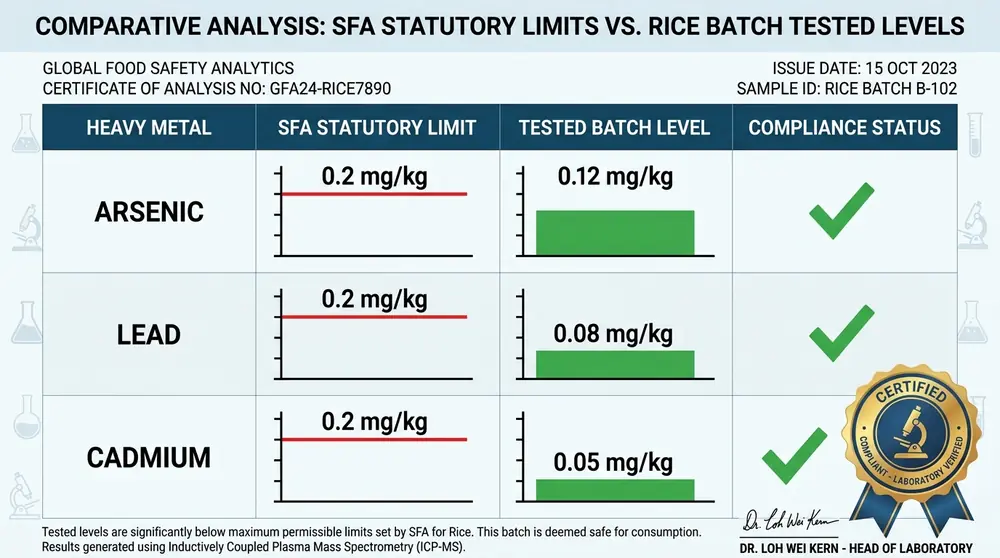
The Ninth Schedule of the Singapore Food Regulations establishes clear statutory thresholds. Inorganic Arsenic is strictly capped at 0.20 mg/kg (ppm) for polished/milled white rice and 0.35 mg/kg for husked/brown rice. Cadmium, a toxic heavy metal that damages renal systems, has an enforceable maximum ceiling of 0.10 mg/kg in milled rice. Lead is restricted to 0.20 mg/kg, while Total Mercury must not exceed 0.03 mg/kg. Consignments exceeding these statutory levels fail automated customs clearance via TradeNet and are condemned under SFA import inspection protocols.
Statutory SFA Heavy Metal & Contaminant Thresholds vs. Draba Ventures Laboratory Benchmarks
| Contaminant / Residue | SFA Maximum Limit (mg/kg) | Draba Ventures Batch Benchmark | Detection Method / LOD | Border Inspection Risk Profile |
|---|---|---|---|---|
| Inorganic Arsenic (As) | ≤ 0.20 mg/kg | < 0.08 mg/kg (Compliant) | ICP-MS (LOD 0.01 mg/kg) | High: Priority SFA targeted testing for milled grains |
| Cadmium (Cd) | ≤ 0.10 mg/kg | < 0.02 mg/kg (Compliant) | ICP-MS (LOD 0.005 mg/kg) | Critical: Instant container hold if threshold exceeded |
| Lead (Pb) | ≤ 0.20 mg/kg | < 0.04 mg/kg (Compliant) | AAS / ICP-MS (LOD 0.005 mg/kg) | High: Mandatory testing across industrial milling zones |
| Total Mercury (Hg) | ≤ 0.03 mg/kg | < 0.005 mg/kg (BLD) | Cold Vapor AAS (LOD 0.002 mg/kg) | Moderate: Baseline annual surveillance monitoring |
| Aflatoxin B1 | ≤ 5.00 µg/kg (ppb) | < 0.50 µg/kg (Compliant) | HPLC-FLD / LC-MS/MS (LOD 0.1 µg/kg) | Critical: Zero-tolerance fungal inspection at Singapore berths |
| Total Aflatoxins (B1+B2+G1+G2) | ≤ 10.00 µg/kg (ppb) | < 1.00 µg/kg (Compliant) | LC-MS/MS (LOD 0.2 µg/kg) | Critical: Cargo destruction mandated upon confirmation |
| Chlorpyrifos (Insecticide) | ≤ 0.05 mg/kg | < 0.01 mg/kg (BLD) | GC-MS/MS (LOD 0.005 mg/kg) | Strict: Banned post-harvest chemical treatment |
| Tricyclazole (Fungicide) | ≤ 0.01 mg/kg | < 0.005 mg/kg (BLD) | LC-MS/MS (LOD 0.002 mg/kg) | Strict: Default Codex limit enforced by SFA laboratories |
Mycotoxins and Aflatoxin Controls in Maritime Transit
While heavy metal content originates in the paddy fields, mycotoxins—specifically Aspergillus flavus fungi producing Aflatoxin B1 and Total Aflatoxins—proliferate during storage and maritime voyage if grain moisture is uncontrolled. Singapore's equatorial climate, characterized by high ambient relative humidity (75–85%) and tropical temperatures (28–32°C), accelerates mold sporulation inside containerized cargo.
The SFA mandates a maximum limit of 5.0 ppb (µg/kg) for Aflatoxin B1 and 10.0 ppb for Total Aflatoxins across all cereal grains. Draba Ventures neutralizes this operational hazard at source: our computer-controlled milling facilities in Gangavathi and Sindhanur mechanically desiccate harvested paddy to precisely 12.0–12.5% moisture content prior to packing. Every 20ft container is sealed with multi-layered polyethylene container liners and industrial calcium chloride desiccant poles, preventing moisture condensation and ensuring zero aflatoxin development throughout the 4–6 day ocean voyage from Chennai Port to PSA Singapore.
Pesticide Maximum Residue Limits (MRL) for Indian Rice Varieties
Singapore operates on an automated positive list system alongside Codex Alimentarius standards. Where a specific national MRL is not gazetted in the Food Regulations, the SFA enforces default limits as low as 0.01 mg/kg. Common agrochemicals historically utilized in conventional paddy farming—such as Chlorpyrifos, Tricyclazole, Buprofezin, and Thiamethoxam—are rigorously scrutinized by SFA border laboratories using high-resolution liquid chromatography-tandem mass spectrometry (LC-MS/MS) and gas chromatography (GC-MS/MS).
Draba Ventures eliminates pesticide contamination through contract farming protocols in the Tungabhadra basin. Farmers receive certified seed varieties and follow strictly scheduled pre-harvest interval (PHI) schedules that prohibit pesticide application within 35 days of reaping. This biological clearance ensures that finished milled Sona Masoori, RNR 15048 Low GI, and IR-64 white rice test below limits of detection (BLD) for over 220 agrochemical compounds.
SFA High-Risk Inspection Regime vs. Draba Ventures Pre-Shipment Quality Protocol
| Procurement & Logistics Stage | High-Risk Conventional Broker Practice | Draba Ventures Laboratory-Backed Protocol | SFA Border Clearance Impact |
|---|---|---|---|
| Paddy Sourcing & Soil Testing | Aggregated spot lots from unverified mandis; no soil or groundwater screening. | Direct farm contract procurement in Raichur/Ballari; soil heavy metal and irrigation water audited. | Eliminates root-cause Cadmium and Arsenic accumulation. |
| Milling & Water Treatment | Untreated river or municipal water used for parboiling steam and polishing mist. | Multi-stage Reverse Osmosis (RO) filtered water for all parboiling and polishing lines. | Zero cross-contamination of heavy metals during grain processing. |
| Pre-Shipment Quality Analysis | No pre-dispatch chemical testing; relies on seller verbal declarations. | Comprehensive batch testing by NABL/SGS/Eurofins accredited independent labs for 220+ residues. | Pre-validated Certificate of Analysis (CoA) submitted in advance. |
| Container Preparation | Standard unlined shipping containers; grain moisture 14.0–15.0%. | Food-grade PE dry liners + 2000g high-absorption desiccant poles; moisture capped ≤ 12.5%. | Prevents sweat-water condensation and aflatoxin formation at sea. |
| Singapore Customs Clearance | Post-arrival manual documentation; cargo flagged for physical sampling and detention. | Pre-arrival electronic TradeNet submission with batch-matched CoA and Phytosanitary Certificate. | Instant green-lane customs clearance; zero demurrage or detention charges. |
Risk-Free Procurement with Draba Ventures Laboratory CoAs
For Singaporean purchasing managers and food importers, the financial consequences of an SFA cargo rejection far exceed the initial purchase value. Cargo destruction charges, demurrage fees at PSA terminals, and brand damage with corporate retail clients like FairPrice or Cold Storage can cripple an import enterprise.
Draba Ventures eliminates this business risk entirely. Every 20ft FCL dispatched from our Karnataka facilities is accompanied by a comprehensive Certificate of Analysis (CoA) issued by globally recognized, SFA-acceptable independent testing authorities (SGS, Eurofins, or Vimta Labs). Our testing panels cover heavy metals via ICP-MS, aflatoxins via HPLC, and multi-residue pesticide screens. Importers review and approve verified laboratory results before the vessel sails from Chennai or Krishnapatnam, providing complete regulatory certainty.
Secure SFA-Compliant Rice Shipments from India
Eliminate import inspection risks with verified pre-shipment lab reports (SGS/Eurofins), competitive FOB/CIF rates, and direct mill supply from Karnataka.
Request SFA Compliance Panel & CIF Quote Inquire via WhatsApp (+91 99165 50010)7. Frequently Asked Questions (FAQ)
Under the Singapore Food Regulations enforced by the Singapore Food Agency (SFA), the statutory maximum limits for milled white rice are: Inorganic Arsenic ≤ 0.20 mg/kg (and ≤ 0.35 mg/kg for husked/brown rice), Cadmium ≤ 0.10 mg/kg, Lead ≤ 0.20 mg/kg, and Total Mercury ≤ 0.03 mg/kg. Consignments testing above these limits are condemned and barred from distribution.
If an import consignment fails SFA laboratory tests at PSA Singapore, the SFA immediately issues an import refusal notice. The cargo must either be re-exported outside Singapore or destroyed under official SFA supervision at the importer's cost. Additionally, future shipments from the supplier and importer are placed on targeted inspection, requiring mandatory pre-clearance holding and fees.
The SFA accepts Certificates of Analysis (CoA) from testing laboratories accredited under the Singapore Laboratory Accreditation Scheme (SINGLAS) or mutual recognition arrangements like ILAC-MRA, such as ISO/IEC 17025 accredited facilities including SGS, Eurofins, TUV, or NABL-accredited premier laboratories in India. The CoA must reflect batch-specific representative sampling utilizing ICP-MS and LC-MS/MS testing methods.
Draba Ventures implements a four-tier quality control architecture: (1) contract farming with controlled pre-harvest agrochemical intervals, (2) reverse-osmosis water polishing, (3) mechanical moisture desiccation to ≤ 12.5% to stop aflatoxin formation during transit, and (4) pre-shipment multi-residue independent laboratory analysis (SGS/Eurofins) for 220+ compounds before maritime dispatch.
