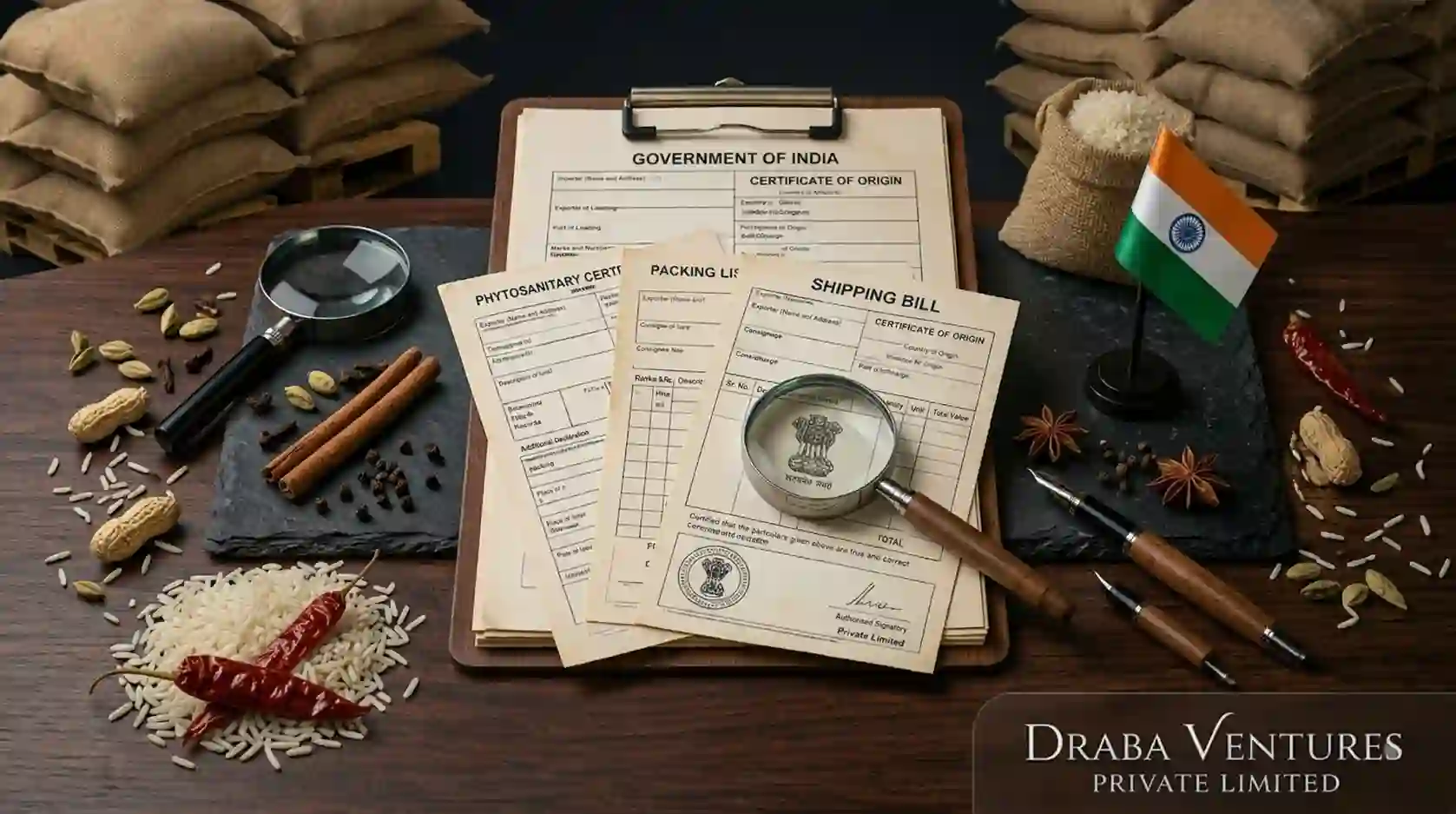
Executive Summary for Importers: The Certificate of Origin (COO) is one of the most commercially consequential documents in international rice procurement. It serves as legal proof that agricultural cargo was harvested, milled, and packaged within India. Under bilateral Free Trade Agreements (such as India-UAE CEPA) or multilateral pacts (SAFTA, AIFTA), a preferential Certificate of Origin enables importers to legally slash or entirely eliminate destination customs tariffs. Draba Ventures manages seamless, digital eSCO application processing before vessel departure, safeguarding your duty exemptions and preventing port clearance hold-ups.
Calculate Landed Costs & Preferential Duty Savings
Estimate real-time FOB and CIF destination costs incorporating preferential tariff benefits for IR-64 Parboiled, Sona Masoori, and Basmati rice.
Types of Certificate of Origin for Rice Export from India
Customs administrations classify Certificates of Origin into two distinct legal frameworks: Non-Preferential and Preferential certificates:
| Destination Market | COO Type | Issuing Authority | Tariff Benefit & Legal Framework |
|---|---|---|---|
| United Arab Emirates (UAE) | India-UAE CEPA Preferential COO | DGFT authorized bodies via eSCO | 0% duty exemption on eligible rice tariff lines |
| Malaysia, Singapore, ASEAN | Form AI (ASEAN-India FTA) | Export Inspection Council (EIC) | Preferential concessional tariff under AIFTA |
| Sri Lanka, Bangladesh, Nepal | SAFTA Preferential COO | FIEO / Authorized Chambers of Commerce | Regional preferential duty reductions under SAARC |
| European Union & United Kingdom | Non-Preferential Standard COO | FIEO / Chamber of Commerce | Origin verification for standard MFN customs clearance |
| Japan, Norway, Switzerland | Form A (GSP Scheme) | Export Inspection Council (EIC) | GSP reduced tariff rates for developing economies |
| Saudi Arabia, Kuwait, GCC (excl. UAE) | Non-Preferential Standard COO | FIEO / Indian Embassy / Chamber | Mandatory proof of origin; standard GCC 5% tariff applies |
Mandatory Documentation for Certificate of Origin Issuance
To secure prompt verification without customs queries, Draba Ventures compiles and verifies all primary cargo documentation prior to filing on the eSCO portal:
| Required Document | Issuing Source | Function & Customs Verification Point |
|---|---|---|
| Commercial Invoice | Draba Ventures Private Limited | Exact grain variety, HS Code (1006.30), FOB/CIF invoice total |
| Packing List | Draba Ventures Export Division | Net/gross metric tonnage, bag count, container and seal numbers |
| Bill of Lading (B/L) | Ocean Shipping Line / Freight Forwarder | On-board confirmation, port of loading, destination discharge port |
| Milling & Origin Declaration | Partner Modern Rice Mill | Verification that paddy was grown and milled within Indian territory |
| Export Registration (RCMC) | APEDA / FIEO | Statutory authorization validating exporter registration in India |
MFN Baseline Tariffs vs. Preferential Tariffs with COO
Presenting the correct preferential Certificate of Origin generates substantial financial savings for overseas grain buyers:
| Destination Country | Trade Agreement | Standard MFN Duty Rate | Preferential Duty Rate with COO |
|---|---|---|---|
| United Arab Emirates | India-UAE CEPA | 5.0% standard tariff | 0.0% Duty-Free (with CEPA COO) |
| Malaysia | ASEAN-India FTA (AIFTA) | Up to 40.0% base tariff | Concessional quota rate |
| Bangladesh | SAFTA Agreement | General import taxes | Substantial SAFTA tariff concession |
| European Union | General MFN Framework | Specific euro/MT duty by variety | Standard MFN (Non-preferential COO required) |
| Saudi Arabia | Unified GCC External Tariff | 5.0% customs duty | 5.0% (Standard COO required for cargo release) |
Step-by-Step DGFT eSCO Digital Application Timeline
India's Directorate General of Foreign Trade mandates that all Certificates of Origin be processed electronically through the eSCO portal:
| Application Stage | Turnaround Time | Responsible Entity | Draba Ventures Compliance Protocol |
|---|---|---|---|
| Portal Registration & IEC Link | Instant / Pre-active | DGFT eSCO System | Corporate profile linked with Class-3 digital signatures |
| Filing & Document Upload | Day of container stuffing | Draba Ventures Export Team | Simultaneous upload of Commercial Invoice & Packing List |
| Scrutiny & Official Approval | 24 to 48 hours | FIEO / EIC / Chamber Desk | Electronic pre-clearance prior to vessel sailing |
| Digital Issuance with QR Code | Immediate upon sign-off | DGFT eSCO Platform | Tamper-proof digital PDF dispatched immediately to buyer |
Rules of Origin Criteria for Indian Rice
To qualify for preferential duty rates under agreements like CEPA, exported commodities must satisfy statutory "Rules of Origin" (ROO):
- Wholly Obtained Goods (WO): Indian rice meets this benchmark because paddy is cultivated, harvested, dried, and processed exclusively on Indian soil. Re-bagging of third-country rice does not qualify.
- Direct Consignment Rule: Goods must be shipped directly from Indian ports (e.g., Chennai, Nhava Sheva, Kakinada) to the importing country without intermediate transit manipulation, preserving duty concessions under through Bills of Lading.
- Processing Traceability: Milling declarations must clearly reference the origin mill location (such as Sindhanur or Siruguppa, Karnataka) to withstand destination customs post-clearance audits.
Frequently Asked Questions
Secure Duty-Compliant Rice Shipments with Draba Ventures
We handle all documentation—including preferential CEPA, SAFTA, and AIFTA Certificates of Origin—ensuring complete customs compliance and maximum duty savings before your vessel arrives.
Request a Quote with COO