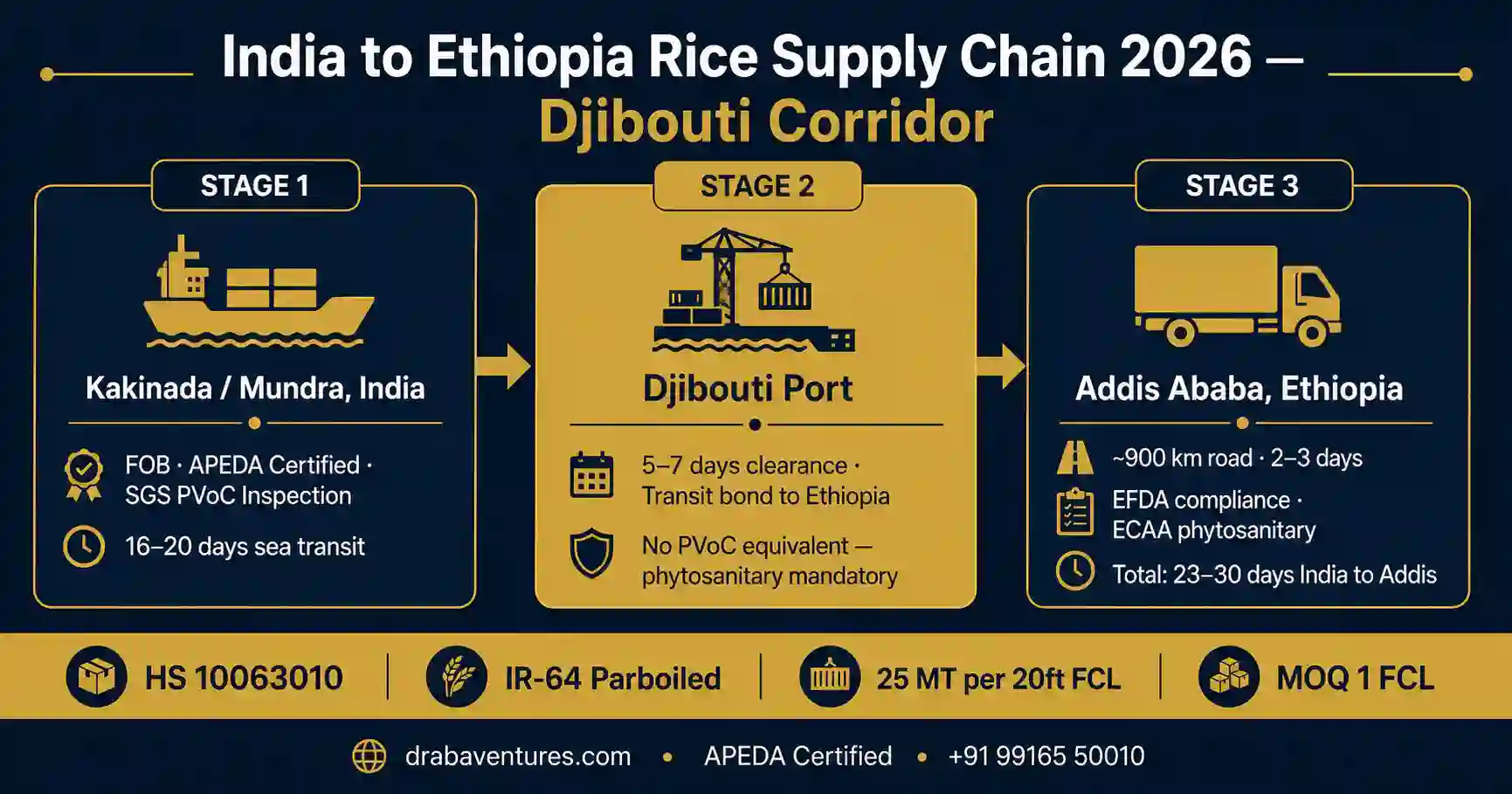
Ethiopian rice imports arrive exclusively via Djibouti Port - ocean transit from Kakinada/Mundra requires 16-20 days, followed by ~900 km road freight to Addis Ababa (2-3 days). Total transit from Indian mill to Addis Ababa is 21-28 days. EFDA (Ethiopian Food and Drug Authority) compliance is mandatory, requiring a Certificate of Analysis alongside standard shipping documents. HS Code is 10063010 (parboiled). With over 80% of domestic rice demand imported, Ethiopia represents a high-growth destination for Indian exporters.
Why Ethiopia
Djibouti Corridor
Pre-shipment Inspection
3-5 days port clearance
Transit bond to Ethiopia
2-3 days transit
EFDA + ECAA clearance
HS Codes
| Rice Variety | HS Tariff Code | Processing Specification | Market Share in Ethiopia |
|---|---|---|---|
| IR-64 Parboiled | 1006.30.10 | Parboiled golden long-grain (5% or 15% broken) | Dominant - institutional & wholesale |
| IR-64 Raw (White) | 1006.30.90 | Milled raw white non-parboiled | Significant - urban retail |
| Swarna / Ponni Parboiled | 1006.30.10 | Medium grain parboiled | Niche - regional catering demand |
| Basmati Rice | 1006.30.20 | Traditional & 1121 long-grain aromatic | Small - premium Addis retail & hotels |
Cost Breakdown
EFDA Compliance
EFDA - Ethiopian Food and Drug Authority
EFDA serves as Ethiopia's primary food safety regulator. All imported rice consignments must meet strict moisture (<=14.0%), aflatoxin, and pesticide residue maximum limits aligned with Codex Alimentarius standards. An NABL-accredited laboratory Certificate of Analysis (CoA) from India is required to avoid cargo detention and quarantine testing at the border.
ECAA - Plant Health & Phytosanitary Control
Phytosanitary inspection is enforced by the Plant Health Regulatory Directorate under the Ministry of Agriculture. An original Phytosanitary Certificate from India's NPPO/PPQ (valid for 21 days from issuance) and an official Fumigation Certificate (phosphine or methyl bromide) are mandatory prior to inland transit dispatch.
ERCA - Ethiopian Revenues & Customs Authority
The Ethiopian importer's customs broker registers the import declaration in the ERCA digital customs portal prior to vessel discharge at Djibouti. Transit bonds are issued at Djibouti to secure customs duty liabilities until arrival at the Addis Ababa dry port (Kality or Modjo).
Foreign Exchange & Trade Finance Management
Foreign exchange liquidity requires careful commercial structuring. Draba Ventures advises transactions backed by confirmed, irrevocable Letters of Credit from Tier-1 Ethiopian commercial banks (e.g., Commercial Bank of Ethiopia, Awash Bank, Dashen Bank) or structured Telegraphic Transfer (TT) advance arrangements.
Checklist
Checklist - 2026
FAQ
How is Indian rice imported into Ethiopia via the Djibouti corridor?
Because Ethiopia is a landlocked nation, over 90% of its maritime cargo enters through the Port of Djibouti. Indian rice is shipped from eastern or western ports (such as Kakinada or Mundra) across the Indian Ocean and Gulf of Aden to Djibouti (16-20 days). Following port customs transit filing (3-5 days), containers are transported approximately 900 km across the road corridor or via the Ethio-Djibouti Railway to dry ports in Addis Ababa (2-3 days), resulting in an end-to-end timeline of 21-28 days.
What are the mandatory EFDA compliance requirements for rice in Ethiopia?
The Ethiopian Food and Drug Authority (EFDA) mandates that all food imports meet national safety standards. For Indian rice, key parameters include moisture content below 14.0%, total aflatoxins within allowable limits, zero live insects, and pesticide residue compliance conforming to Codex Alimentarius. Providing a verified Certificate of Analysis (CoA) from an accredited Indian laboratory alongside the phytosanitary certificate ensures expedited clearance without border detention.
Why is Ethiopia a major destination for Indian IR-64 parboiled rice?
Ethiopia has a population exceeding 130 million people with urban rice consumption expanding at 12-15% annually. Because domestic production meets less than 20% of national requirements, the country relies on imported parboiled rice for institutional catering, restaurant chains, and household consumption. Indian IR-64 Parboiled provides the ideal combination of grain elongation, cooking firmness, and cost efficiency demanded by the Merkato wholesale market.
How can importers manage foreign exchange and payment terms when buying from India?
Due to foreign exchange liquidity considerations in Ethiopia, importers should work with established financial institutions such as the Commercial Bank of Ethiopia, Awash Bank, or Dashen Bank. International rice contracts are typically settled via irrevocable, confirmed Letters of Credit (LC at sight) or structured advance Telegraphic Transfers (TT), ensuring complete transparency and trade security for both buyer and supplier.
What is the typical trucking cost from Djibouti Port to Addis Ababa?
Inland road freight for a 20ft container (loading 25 metric tons) from Djibouti to Addis Ababa generally ranges between $1,200 and $1,800 USD, influenced by seasonal diesel prices, container turnaround speed, and corridor vehicle availability. Rail freight via the Ethio-Djibouti Railway provides an alternative route for bulk container movements under scheduled operations.
Import Indian Rice to Ethiopia 2026
Ethiopia is one of East Africa's largest rice consumer markets. With no seaport of its own, all Indian rice arrives via Djibouti Port followed by a 900 km multimodal road corridor to Addis Ababa. EFDA quality compliance, ECAA phytosanitary clearance, Djibouti transit procedures, and the IR-64 parboiled wholesale opportunity.