Global agricultural commodity markets are subject to intense seasonal volatility. For Singaporean rice importers, distributors, and supermarket procurement heads, unpredictable price fluctuations erode operational margins. Volatility is frequently compounded by monsoon variability across key Indian river basins, speculative domestic hoarding, and opaque multi-tier broker markups at primary assembly markets.
Draba Ventures removes market opacity by deploying an enterprise-grade data infrastructure that continuously tracks over 120 months of historical mandi prices across major APMC (Agricultural Produce Market Committee) hubs in Karnataka and Andhra Pradesh. By coupling econometric time-series models with real-time crop arrival tracking, we provide Singaporean buyers with actionable procurement signals, enabling forward contracting at cyclical pricing troughs rather than chasing reactive market peaks.
Decoding the Kharif and Rabi Harvest Cycles
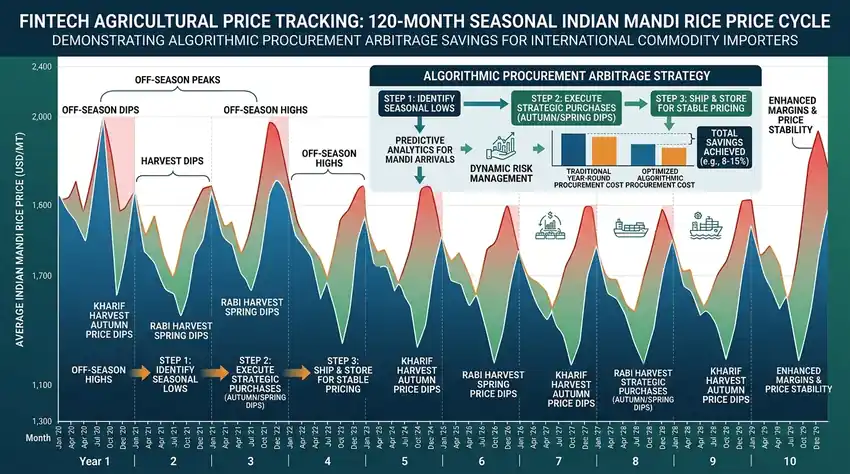
Indian non-basmati rice procurement follows two distinct harvest cycles: the Kharif (monsoon) harvest arriving between November and January, and the Rabi (winter/irrigated) harvest entering mandis between April and June. During peak arrival weeks, daily arrivals at terminal mandis such as Sindhanur, Gangavathi, Raichur, and Kurnool surge dramatically, exerting intense downward pressure on spot paddy prices.
Conversely, the inter-harvest lean periods—particularly July to September—experience tight market supplies as commercial millers and state agencies compete for dwindling farm stocks. Spot mandi prices regularly surge by 14% to 22% during these months. Rather than procuring on a rigid monthly schedule, our predictive models identify the exact 10-to-15 day windows when physical arrivals peak and mill-gate prices reach statistical minimums. Sourcing during these windows enables Singapore importers to lock in substantial FOB cost savings on 20-foot and 40-foot containerized bookings.
Eliminating Middleman Markup via Direct Mill APIs
Traditional export channels rely on fragmented networks of commission agents, local village aggregators, and speculative port traders. Each intermediary layer tacks on an unearned margin of USD 15 to USD 28 per metric ton, whilst offering zero legal guarantees regarding milling specifications, moisture control, or Singapore Food Agency (SFA) chemical residue compliance.
Draba Ventures replaces this speculative intermediary chain with direct digital integration into our modern milling hubs in Sindhanur and Karatagi. Our pricing engine links directly with mandi electronic trading logs, calculating real-time parboiled and raw white processing yields, container stuffing costs, freight rates from Chennai/Kakinada to PSA Singapore, and statutory port dues. Singaporean importers receive mathematically transparent CIF quotes verified against primary market fundamentals.
Table 1: Indian Mandi Price Seasonality & Optimal Sourcing Windows for Singapore Buyers
| Harvest Season & Period | Mandi Arrival Volume Trend | Modal Price Movement | Optimal Importer Procurement Action | FOB Rate Impact (USD/MT) |
|---|---|---|---|---|
| Early Kharif (Nov - Dec) | Heavy arrivals (Sindhanur & Gangavathi) | Seasonal price bottom (Paddy index low) | Lock in primary annual volume via 90-day forward contracts | FOB floor: USD 640 - 680 / MT |
| Late Kharif (Jan - Feb) | Arrivals stabilize, moisture normalizes | Moderate price recovery (+4% to +6%) | Execute spot orders for immediate Q1 retail supermarket stock | FOB range: USD 670 - 710 / MT |
| Pre-Rabi Lean (Mar) | Arrivals taper, mill stocks tighten | Temporary price spike (+8% to +12%) | Hold procurement; draw down existing Singapore warehouse buffer | FOB peak: USD 720 - 760 / MT |
| Rabi Harvest (Apr - May) | Secondary arrival surge (Canal-irrigated) | Second seasonal dip (-6% to -10%) | Replenish inventories for mid-year food service & festive demand | FOB floor: USD 660 - 700 / MT |
| Monsoon Lean (Jul - Sep) | Minimal mandi arrivals, open-market scarcity | Annual price peak (+15% to +22%) | Avoid spot purchases; rely on pre-booked algorithmic forward stock | FOB peak: USD 750 - 810 / MT |
Algorithmic Direct Procurement vs. Speculative Trading
To demonstrate the tangible financial impact of data-backed procurement, we contrast the landed economics of a typical 26 metric ton (1,040 bags of 25kg) container shipment handled through conventional broker networks versus Draba Ventures' direct mill algorithm.
Because our procurement timing aligns with historical price bottoms and our direct supply bypasses speculative broker layers, Singapore importers achieve an average savings of USD 45 to USD 65 per metric ton. Across an annual volume of 50 containers (1,300 metric tons), this algorithmic cost reduction preserves over USD 70,000 in bottom-line margin for the importer.
Table 2: Financial Impact: AI-Driven Direct Sourcing vs. Traditional Brokerage (20ft FCL / 26 MT Basis)
| Procurement Parameter | Traditional Broker Sourcing | Draba Ventures AI Direct Sourcing | Net Economic Advantage (SGD) |
|---|---|---|---|
| Baseline Mill-Gate Price | Purchased during reactive demand peaks | Procured at algorithmically timed arrival dips | SGD 52 / MT base grain savings |
| Intermediary Broker Commission | USD 18 - 25 / MT (SGD 24 - 34 / MT) | SGD 0 / MT (100% direct-to-mill purchase) | Full broker markup eliminated |
| Milling Sortex Quality Guarantee | Variable (<98% Sortex purity, mixed broken) | Certified 99.5% Sortex clean, <2.0% broken | Zero quality rejection at PSA terminal |
| SFA Chemical Residue Screening | Importers bear risk of port detention | Pre-shipment SGS/Eurofins lab certified | Protected against costly re-export penalties |
| Total Landed Cost per 26 MT FCL | SGD 28,600 (SGD 1.10 / kg) | SGD 26,450 (SGD 1.017 / kg) | Net savings: SGD 2,150 per 20ft container |
| Annualized Savings (50 Containers) | SGD 1,430,000 total outlay | SGD 1,322,500 total outlay | SGD 107,500 annual profit retention |
Execution Rigour: SFA Laboratory Panels & Port Logistics
Data intelligence is only as valuable as the physical supply chain executing it. Once our predictive engine executes procurement triggers, grain lots undergo immediate standardized testing at accredited laboratories prior to bagging. Shipments are verified against Singapore Food Agency (SFA) regulatory standards, ensuring compliance with heavy metal limits (Lead <0.2 ppm, Cadmium <0.1 ppm, Inorganic Arsenic <0.2 ppm) and zero synthetic pesticide residue exceedances.
Consignments are loaded at automated milling facilities in Raichur and transported via dedicated rail corridors to Chennai Port or Kakinada Port. By coordinating directly with container liner services offering direct 4-to-6 day transit to PSA Singapore, we ensure that the cost advantages secured through mandi intelligence are preserved through seamless maritime logistics.
Access Proprietary Mandi Intelligence for Your Singapore Rice Supply
Schedule a briefing with Draba Ventures' trade desk to review current mandi arrival trends and lock in data-backed CIF Singapore contracts.
Request Real-Time Rate Analysis Direct WhatsApp Trade DeskFrequently Asked Questions
By tracking 10 years (120 months) of daily arrival volumes and modal pricing data across primary agricultural markets (mandis), our predictive algorithms forecast harvest price bottoms with high accuracy. This allows Singapore buyers to execute bulk procurement during peak arrival windows when raw paddy is cheapest, rather than buying reactively during off-season price spikes.
The Kharif harvest (November to January) represents the primary annual crop arrival with maximum volume and lowest baseline prices, making it the ideal window for long-term forward contracting. The Rabi harvest (April to June) offers a secondary arrival surge with lower grain moisture content, providing an excellent window to replenish stocks for mid-year retail and catering demand.
Traditional exporters purchase through multi-tier commission agents and speculative traders who add USD 15 to USD 28 per metric ton in hidden spreads. Draba Ventures connects Singapore importers directly to our automated milling network in Karnataka, eliminating all intermediary fees and providing transparent, itemized FOB and CIF cost structures.
Yes. We offer forward contracting structures that allow Singapore importers to lock in firm CIF Singapore pricing up to 90 days in advance, backed by physical paddy inventory hedged in our climate-controlled warehouses in Karnataka.
